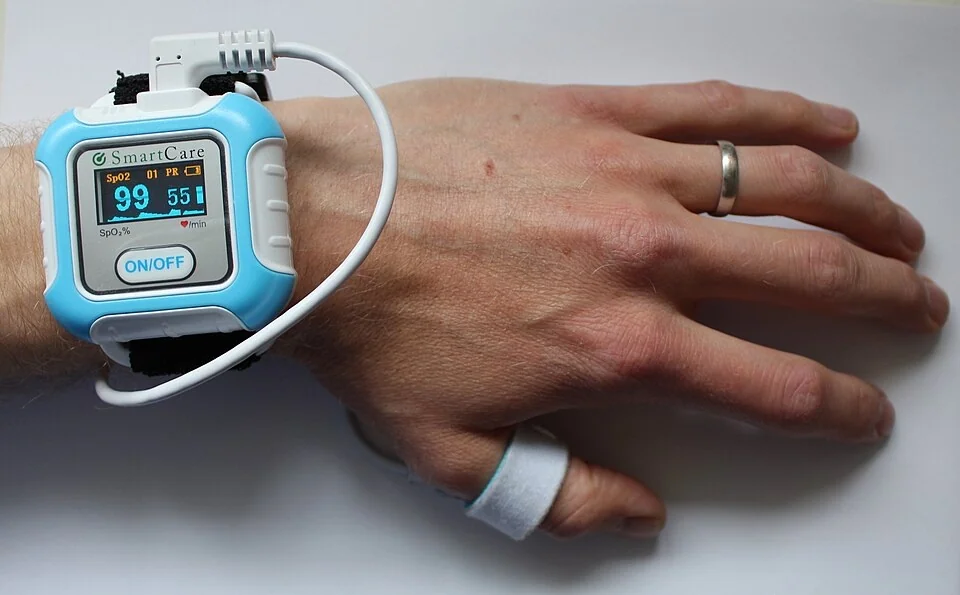
- ChromaSense measures reflected light and adapts its settings to the wearer.
- Researchers compared the prototype with a blood-based reference across a controlled 70% to 100% saturation range.
- Performance in healthy volunteers cannot establish clinical outcomes for critically ill patients.
Inside this story 2 perspectives
A number on a pulse oximeter can look reassuringly precise. Yet the instrument uses light to estimate how much oxygen the blood is carrying, and skin, blood flow and the position of the sensor can affect the signal it receives. A team at Tufts University is trying to account for one source of variation before making the estimate. Its wrist-worn prototype measures how the wearer’s tissue reflects light and then adjusts its own settings.
In an account released on 7 August, the team described how ChromaSense performed when oxygen levels in healthy adult volunteers were briefly reduced under laboratory supervision. That is a more demanding question than asking whether an instrument agrees with another device when almost everybody in the room has a normal reading. Clinicians need particular confidence in a reading when oxygen levels are falling.
Light returning to the wrist
Many familiar finger clips send red and infrared light through the finger. Blood carrying different amounts of oxygen absorbs the wavelengths differently. ChromaSense instead detects light reflected from the wrist. It first characterises the light returning from the individual wearer, then adjusts the intensity it emits and the way it processes the signal. That gives the instrument a means of adapting to different optical conditions.
The distinction matters because a device can perform well on average and still be less reliable in a particular group. Errors in opposite directions can partly cancel in an overall average. Reliable testing therefore requires attention to who took part, the range of oxygen levels recorded and what reference the device had to match. A large set of nearly identical normal readings would tell a clinician very little about performance during deterioration.
What the testing covered
An earlier assessment included 50 people with different skin tones, measured at normal oxygen levels. For the more demanding comparison at the University of California, San Francisco, researchers tested healthy adults over a controlled range of 70% to 100% saturation and compared the wrist readings with a blood-based reference. The Tufts account reports an aggregate accuracy figure of 2.87% and says no skin-tone-dependent bias was apparent in that test.
An aggregate accuracy statistic is not a promise that every individual reading will fall within that distance of the reference. Healthy adults undergoing a controlled test also differ from seriously ill patients, whose circulation and clinical condition can change rapidly. The study did not establish that using this prototype improves treatment decisions or outcomes on a ward.
For someone assessing a new clinical device, the useful question extends beyond whether it worked under an investigator’s supervision. Which patients still need to be studied, and under what circumstances do the errors become large enough to change a decision? Asking those questions makes a promising engineering result easier to interpret, especially for the people whose skin tones earlier generations of sensors have served poorly.