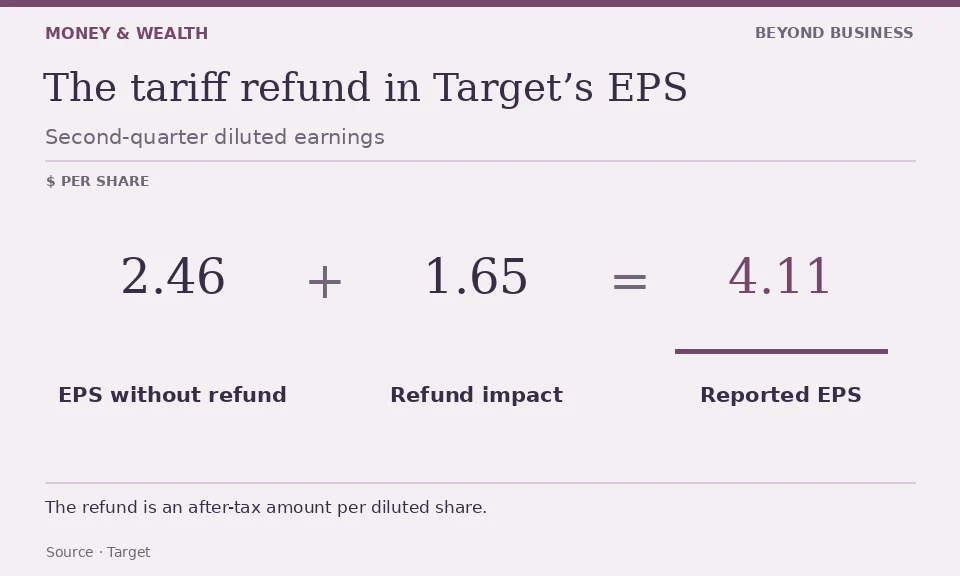
- A tariff refund added $1.65 to reported diluted earnings per share.
- Excluding the refund, Target reported EPS growth of about 20%.
- Comparable traffic rose 3.6%, alongside a 3.8% increase in comparable sales.
Inside this story 2 perspectives
Target reported $4.11 in diluted earnings per share for its second quarter, up from $2.05 a year earlier. Someone scanning the results on 19 August might conclude that the retailer’s normal business had doubled its earnings power. Target itself provided the figure needed to test that reading. A tariff refund contributed $1.65 a share during the quarter.
Subtracting the refund leaves approximately $2.46 per share. Against the prior year’s $2.05, that implies growth of about 20%. It is a substantial increase, but it tells a different story from a doubling. The retailer’s commonly quoted adjusted earnings figure also includes the refund this quarter. Seeing the word “adjusted” beside the total does not answer which adjustments the company has made.
Follow the refund through the accounts
Target said it recorded a $994 million benefit before tax in gross margin and operating income. After tax, the benefit added $752 million to net earnings. Those are two views of the same item. Adding them together would count it more than once. The $1.65 per-share figure expresses the after-tax benefit across the diluted share count.
The distinction also changes the apparent level of profitability. Target reported an operating margin of 9.6%, with 3.7 percentage points attributable to the tariff refunds. Take away that contribution and the arithmetic leaves about 5.9%. The prior-year operating margin was 5.2%. Improvement remains visible, although the gap is much narrower than the two headline operating profit totals suggest.
The trading figures help explain why some improvement remains. Net sales reached $26.5 billion, up 5.3%. Comparable sales, which focus on a more consistent base, rose 3.8%. Target reported a 3.6% increase in comparable traffic, suggesting that a larger number of transactions accounted for most of that gain. Digital comparable sales rose faster than store comparable sales, and same-day delivery grew by more than a quarter, according to the company.
What travels into the forecast?
The annual forecast also includes the refund. Target put its full-year diluted earnings range at $9.90 to $10.90 and specified that it includes about $1.65 a share from the second quarter’s refund. A reader who subtracts it from this quarter’s figures should use the same convention when comparing the full-year guidance. Otherwise the comparison quietly changes definitions midway through the calculation.
There is an equally good reason to retain the original figure on the page. The refund affected the reported accounts and has economic value to the business. Removing it answers a question about the quarter’s underlying trading performance. Keeping it answers a question about what the company actually reported. For a reader weighing the results, two clearly labelled lines in a notebook say more than a single growth percentage.