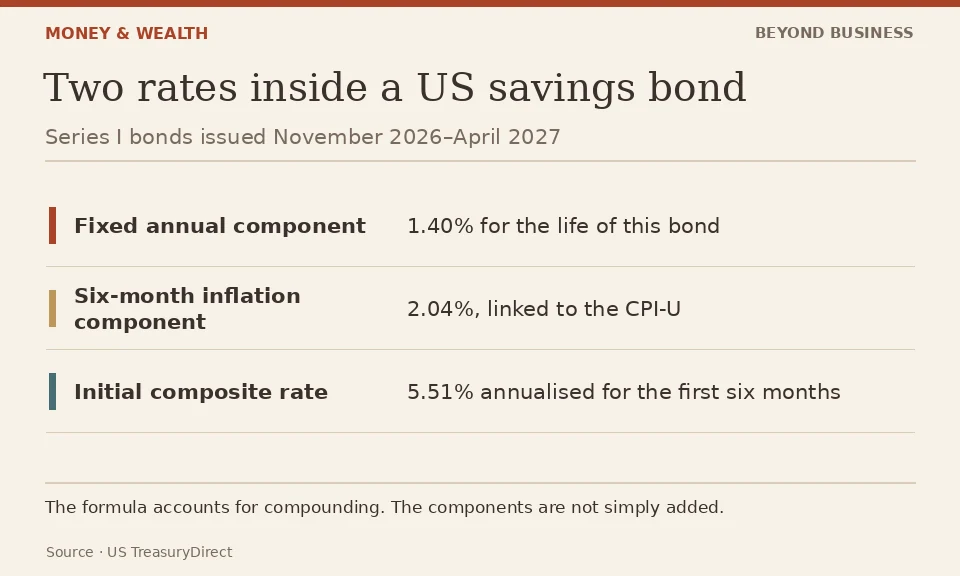
- New US Series I bonds issued from November through April carry a 1.40% fixed component.
- The initial 5.51% is an annualised rate applied for the first six months after issue.
- An older bond keeps the fixed rate attached to its own issue date.
Inside this story 1 perspectives
The United States Treasury’s November savings bond announcement places two attractive-looking figures beside each other. New Series I bonds carry an annualised composite rate of 5.51% for their first six months. They also have a fixed component of 1.40% that lasts for the life of the bond. A saver who mistakes the first figure for the second could make a long-term calculation on a rate that is guaranteed for only one period.
The Bureau of the Fiscal Service’s 2 November announcement applies to new issues from November 2026 to April 2027. That six-month window determines which fixed component a newly purchased bond receives. There is another six-month period that belongs to the individual bond. Its initial composite rate applies for six months from issue, so two savers buying in different months can receive the same starting rate and reach their next adjustment at different times.
How 1.40 and 2.04 become 5.51
TreasuryDirect says the inflation measure rose 2.04% over the six months used for this calculation. It uses the non-seasonally adjusted Consumer Price Index for All Urban Consumers, including food and energy. The combination of the annual fixed component, twice the semiannual inflation rate and a small adjustment for the interaction of the two produces the published annualised composite rate of 5.51%. Simply adding 1.40 and 2.04 would mix an annual rate with a six-month movement and give the wrong answer.
Annualised is another important word in the announcement. A rate expressed on an annual basis makes rates easier to compare. It does not mean the holder receives 5.51% of the purchase amount after six months. Nor does it establish the rate that will apply over the following six months. The next inflation adjustment depends on what happens to the price index during the relevant comparison period.
Someone holding an older I bond faces a different calculation. The fixed component stays with the bond acquired at the original issue date. It does not rise to 1.40% because new bonds now carry that rate. An older issue can therefore receive the same new inflation component and still have a different composite rate when its own adjustment arrives. TreasuryDirect also explains that the composite rate has a floor of zero if inflation turns sufficiently negative.
The useful checks are the issue month, the fixed rate attached to it and the period for which the displayed composite rate applies. Each describes a different feature of the savings bond. Reading them together turns a large headline percentage into a timeline a saver can use without making a promise about future inflation.