- Sales rose 4.9%, and the company’s comparable-sales measure increased 2.2%.
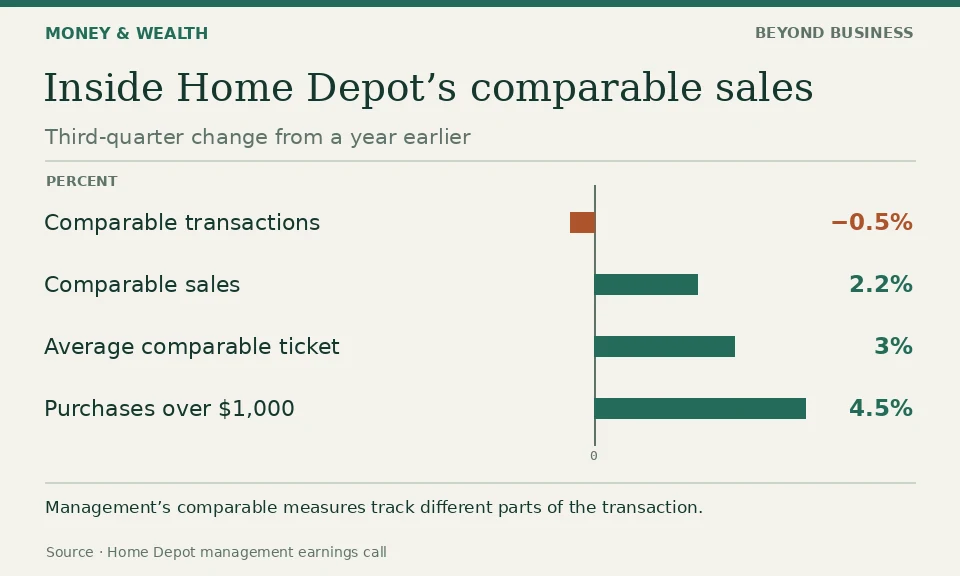
- Comparable transactions fell 0.5%, even as average comparable spending per transaction rose 3%.
- Power equipment and appliances helped lift transactions above $1,000. Full-year projections remain management estimates.
Inside this story 2 perspectives
Replacing a broken refrigerator and commissioning a new kitchen both put money through a home-improvement till. Only one necessarily says a household feels ready to remodel. That distinction runs through Home Depot’s latest results, released on 17 November. The retailer recorded $43.4 billion in quarterly sales, up 4.9% from the equivalent quarter last year. Yet customers made slightly fewer transactions on the company’s comparable basis.
What changed was the size of the receipt. Home Depot told investors its average comparable ticket rose 3%, while comparable transactions fell 0.5%. Purchases over $1,000 increased 4.5% on the same basis. Management pointed to demand for appliances and power equipment. An expensive purchase, in other words, could be a single essential replacement or a contractor’s tool, as well as the start of a much larger project.
Three views of the same till
Total revenue captures the business Home Depot operates today, including activity brought in through acquisitions. Its comparable-sales measure asks how sales have changed across a more consistent set of operations. That measure rose 2.2% in the quarter, both group-wide and in the United States. The gap between the two growth rates is a reminder to look at which businesses went into each comparison.
Professional customers also complicate the picture. Both professionals and do-it-yourself customers generated positive comparable sales, according to management, with the professional side growing faster. A contractor collecting materials for several jobs can make one purchase that looks nothing like a homeowner’s Saturday trip. A retailer can therefore increase sales even if fewer purchases pass through its tills.
Which orders will carry over?
For a manufacturer of cabinet fittings in South Africa, or a distributor assessing a potential overseas customer, that mix changes what an upbeat results announcement can tell them. Imagine a buyer whose revenue is growing because refrigerators sell well, while multi-room renovations are being deferred. Its next appliance order and its next order for decorative cabinet handles could head in different directions. Product-level demand and the timing of repeat orders would be more informative for that supplier than the buyer’s total turnover.
There is fresh responsibility at the top, too. Home Depot named finance chief Richard McPhail as its next chief executive, effective 23 November. Management’s revised outlook envisages roughly 4.5% sales growth for the full fiscal year and around 1.4% comparable growth. Those are projections, with the remainder of the trading year still to come.
The next results will give investors another pair of numbers worth reading together: how many transactions took place, and how much each one was worth. If the first begins rising alongside the second, that would give a different picture of demand from another quarter carried by larger individual purchases.