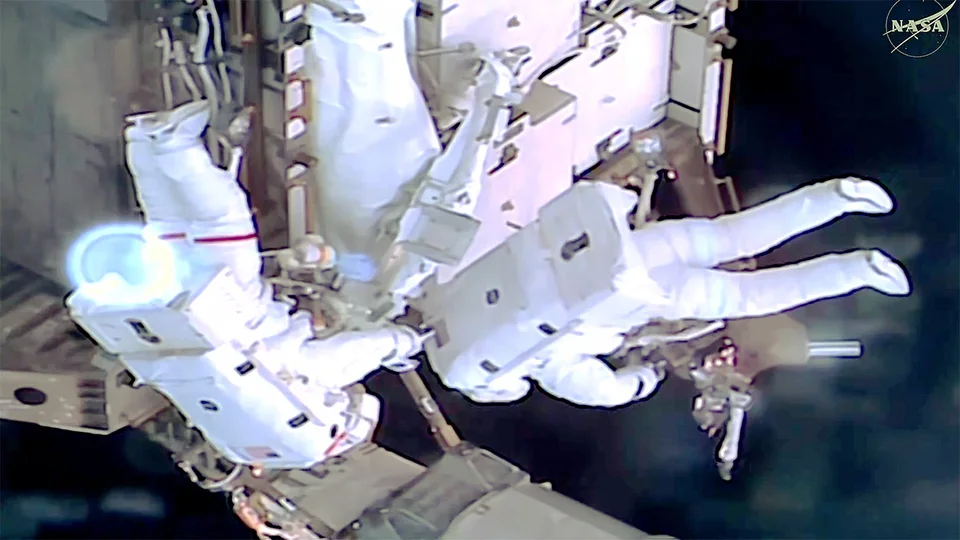
- The spacewalk on 6 August lasted six hours and 27 minutes.
- Meir and Menon prepared power channel 3B for a future roll-out array.
- NASA says additional power will support operations and eventual controlled deorbit.
Inside this story 2 perspectives
Jessica Meir and Anil Menon spent six hours and 27 minutes outside the International Space Station on 6 August to make room for a solar array that has yet to be installed. Their destination was a specific section of the station’s electrical system, power channel 3B. By the time the astronauts were back inside, the station had a place to mount a future source of electricity. The new wing had yet to generate a watt.
The distinction hardly diminishes the work. A solar array that unfurls successfully can do little for the laboratory unless somebody has already prepared the support that will hold it and the route that will carry the electricity. Much of what the crew achieved on Thursday will be least visible at the moment the upgrade eventually starts paying off.
A place for the next wing
The original solar arrays still provide power. Their output has diminished with age, as engineers expected. The newer roll-out wings are designed to work alongside them. Space.com’s account of the outing describes how the crew assembled and secured mounting hardware, routed cables and covered structural pieces with insulating material for protection. Each of those steps changes what another crew can do when the array arrives.
It is an incremental approach to an operating laboratory. The station cannot shut down while every old component is taken out and every new one is installed at leisure. Keeping useful equipment in service preserves some generating capacity during the transition. Installing the support before the new wing also divides the job into tasks that can be scheduled around the station’s other work and around the delivery of hardware from Earth.
This was Menon’s first spacewalk and Meir’s sixth. On Friday NASA reported an unexpected reading from a carbon dioxide sensor on Menon’s suit towards the end of the outing. Menon reported no other issues during the spacewalk. A reading is a measurement from a particular instrument, and its cause needs investigation. NASA’s account did not establish that the astronaut had suffered a medical problem.
Why add power near the end of a mission?
Even a station preparing for an eventual retirement needs dependable electricity. NASA says the added supply will support essential systems and preparations for a controlled deorbit. A spacecraft does not cease to need power on the day its scientific programme winds down. Communications, controls and the equipment that supports people on board still have jobs to do.
The next image of a new wing unrolling may be an easier moment to recognise as progress. Thursday’s contribution will already be there in the frame. The power channel will have a mount and cabling because two people went outside, found the right part of a very large structure and completed the work before the panel arrived.