- Recyclers speaking at a South African industry webinar identified collection and transport as barriers to scale.
- Recovering materials and finding a buyer willing to pay for them are separate challenges.
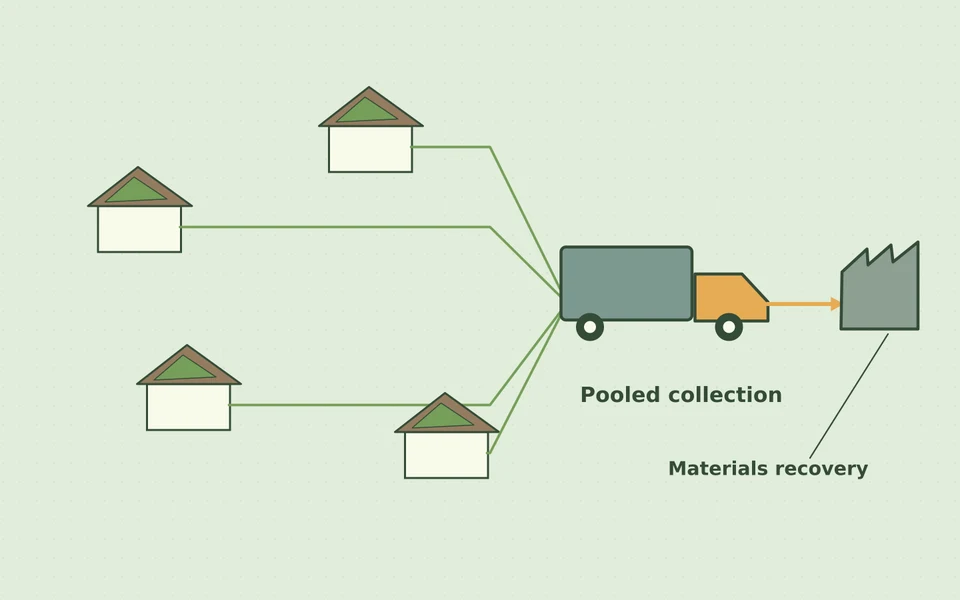
- Pooling collections could improve the economics for smaller installations spread over long distances.
Inside this story 2 perspectives
When a solar panel comes down from a roof, its aluminium frame, glass and metals still have uses. Getting those materials to someone willing to pay for them can be the expensive part. At a South African Photovoltaic Industry Association webinar on 19 November, recyclers described how improvements inside a processing plant can be swallowed by the cost of collecting panels outside it.
Reporting on the discussion, Engineering News said Reclite SA managing director Steffen Schröder had seen processing costs fall while logistics costs climbed. His company works with smaller recycling and transport businesses near large renewable-energy plants. That brings local companies into the work and can reduce the distance a vehicle must travel for a collection.
A tonne of glass still needs a buyer
Solar modules contain a great deal of glass by weight. At first glance that sounds promising for a business paid to recover materials. Yet a recycling plant earns according to the material it can sell, the condition a purchaser needs it in and how far that material must travel. Being able to separate a component tells only the first part of the story.
An international survey published by the IEA Photovoltaic Power Systems Programme in 2025 found a similar difficulty across the markets it examined. Limited volumes, transport challenges and underdeveloped markets for recovered materials made recycling costly relative to the income available. The report also identified opportunities to recover higher-value materials to a purity that customers could use.
At the South African discussion, Krysp managing director Danny Sejeng pointed to established metal users as potential buyers. He also described local tests involving glass in asphalt. A test is one step. A recycler planning collections needs to know that a buyer will take a given quantity, at an agreed quality, often enough to justify running a vehicle.
What a rooftop owner can ask
A large solar plant may have enough retired equipment in one place to fill a vehicle. A school, shop or household replacing a handful of damaged modules faces a different calculation. Five separate journeys for five small loads can quickly narrow the margin on materials with modest resale value. A collection shared across several sites could change that arithmetic if someone coordinates the timing and storage.
For a business comparing installation offers, the end of the panel’s life therefore deserves a line in the discussion. Who arranges collection? Can it be combined with other jobs? What documentation will show where the equipment went? A credible answer may depend as much on a local transport partner and a regular collection day as on the technology inside the recycling plant.