- Tristan Hoare Gallery’s exhibition runs from 16 to 20 September in London.
- The project translates eight Esther Mahlangu compositions into handwoven dhurrie tapestries.
- The artist learned Ndebele painting from her mother and grandmother and has worked across walls, canvas and other surfaces.
Inside this story 2 perspectives
Esther Mahlangu paints a line freehand. An artisan at a loom has to construct one row by row. What joins those two ways of working is the subject of a short exhibition at Tristan Hoare Gallery in London, running from 16 to 20 September. Eight of the South African artist’s compositions have been translated into dhurrie tapestries, developed with Alexandra de Cadaval and handwoven by artisans working in the Indian tradition.
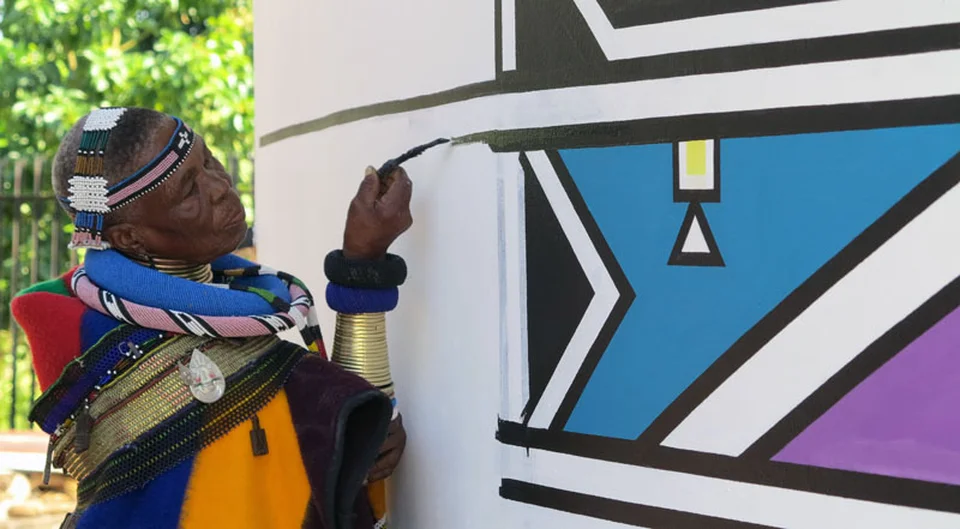
The group of works brings a familiar visual language into a less familiar material. Mahlangu learned Ndebele painting from her mother and grandmother. Women painted bold geometric forms onto the exterior walls of homes, where the design could respond to the shape and proportions of a particular building. Mahlangu carried that knowledge onto canvas and other surfaces. Her international exhibition history includes the Paris show Magiciens de la Terre in 1989. A London audience could also see her large outdoor mural at the Serpentine from 2024 into early 2026.
What it takes to move a line
The precision in Mahlangu’s paintings can look as if it required a ruler. Serpentine describes her use of feathers and brushes to paint by hand, without tape or stencils. That makes the apparent geometry the product of repeated judgement. The width of a band, its direction and the distance to the next colour arise from what the painter does on the surface.
Weaving places a different set of decisions between the composition and its viewer. A painted edge can continue for the length of a gesture. On a loom, a boundary between colours has to be carried through as the textile is built. The resulting line belongs both to the artist who conceived its place in the composition and to the artisans who worked out how to realise it in thread.
The gallery says the project developed over several years, including time de Cadaval spent with Mahlangu at her South African home refining colour and composition. That history of discussion gives more substance to the idea of translation. There was room to reconsider a design for the material instead of treating the finished painting as a simple pattern to transfer.
Read the credits, then look again
A useful way to approach the display is to follow a single boundary between colours. From a distance it helps hold the larger composition together. At close range the same boundary invites a different question about the repeated actions that made it. Neither view requires a visitor to know the symbolic meaning of every form.
The collaborators bring separate histories to that meeting. Ndebele mural painting, Mahlangu’s individual career, de Cadaval’s work on the project and Indian weaving skills all contribute to what hangs in the gallery. Giving those contributions their names makes the change of material more interesting. What travels across the exhibition is a composition, and what changes along the way is how a human hand makes it visible.