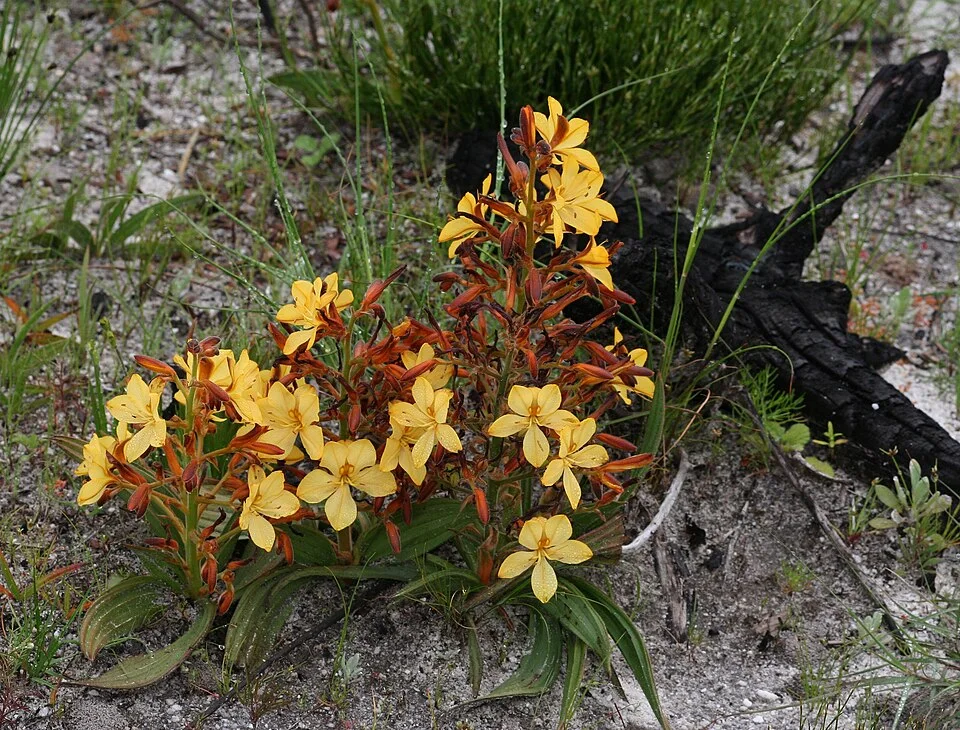
- All the flowers on an individual butterfly lily studied by the team have the same handedness.
- The positions of the pollen-producing and pollen-receiving parts complement those of the opposite form.
- Watching an inverted bud develop helped reveal the part gravity plays.
Inside this story 2 perspectives
Two butterfly lilies can grow side by side on the Cape Peninsula, looking much alike until someone peers into the flowers. On one plant the slender structure that receives pollen bends to the left. On its neighbour it can bend to the right. Now look at the next blossom on each stem. It follows the same pattern as the other flowers on that plant.
A study in Science has traced how the lilies produce this striking consistency. In an account published on 3 August, the University of Cape Town’s Department of Molecular and Cell Biology related one of the least predictable moments in the investigation. A developing bud was accidentally positioned upside down while the researchers were recording it. Master’s student Caroline Robertson saw the developing organs reverse their orientation. Gravity had entered the picture.
What the insect carries away
The alignment matters because the parts of a flower do different jobs. The central stamen bears pollen. The style ends in the stigma, the surface that receives pollen. In these lilies the central stamen and style generally point in opposite directions. A visiting pollinator can pick up pollen on one side of its body. The receiving surface of a flower with the opposite arrangement is in position to meet that side on a subsequent visit.
That offers an answer to a question a gardener might reasonably ask. If one shape works, why have two? A plant surrounded exclusively by neighbours of its own orientation would lack that convenient alignment between the place where pollen was deposited and the place where it is needed. Each form gains from the presence of the other.
A field observation meets genetics
The scientists identified a group of inherited genetic elements that travel together, known as a supergene. It contains two candidate genes linked to the contrasting positions of the male and female organs. Unusual plants found in the field offered another clue. Where both organs pointed the same way, the normal coordination between them had broken down, giving researchers a chance to examine the separate contributions.
The inverted bud added a piece of information a genetic comparison alone could scarcely supply. A developing flower also needs a reference for direction. A change in its physical orientation could alter how the emerging parts were positioned. The evidence brought together a pattern visible in the field, the inheritance of that pattern and a cue encountered by a growing bud.
For readers in Cape Town, some of the evidence is unusually close to hand. UCT points to Rondebosch Common, where two species can flower in August and September. A close look across several plants, leaving the blooms where they are, reveals the feature that first made the question worth asking.