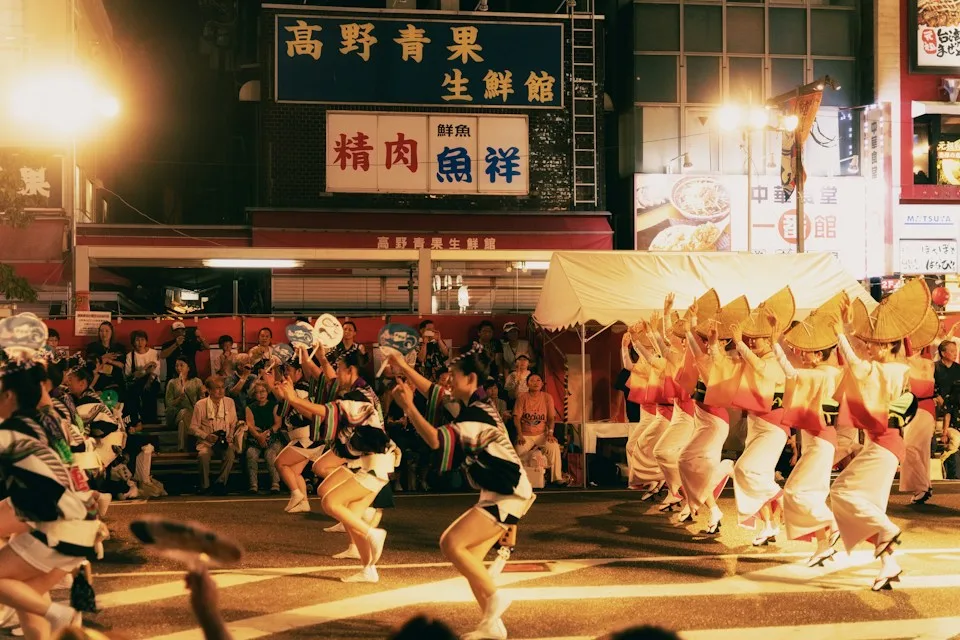
- Tokushima City’s main 2026 performances run from 12 to 15 August.
- A troupe is called a ren, and lanterns at the front identify the group and help set its pace.
- Visitors can watch a scheduled performance or look into the beginner-friendly Niwaka Ren.
Inside this story 2 perspectives
At the front of a Tokushima dance troupe, two paper lanterns carry the group’s name high on a bamboo pole. The prefecture’s guide to Awa Odori explains a detail a visitor might otherwise miss. The person holding the pole helps set the speed at which the group advances. Watch the lanterns for a moment before turning towards the dancers’ feet, and the procession begins to make a different kind of sense.
Tokushima City’s main festival runs from 12 to 15 August. Its paid outdoor programme lists evening starts at 6pm and 8.20pm local time. Those slots are useful landmarks for someone arranging a first visit, but the dance has a vocabulary that travels beyond the ticketed seats. A troupe is a ren. Some have long histories, while others bring together colleagues or students. Recognising a group’s name lets a visitor watch for something more specific than the next wave of dancers.
A procession you can hear approaching
The repeated two-beat rhythm has its own name, zomeki. The instruments Tokushima lists include a large drum, a smaller high-pitched drum, a gong, a flute and the shamisen, a three-stringed instrument. One way to listen is to follow the same sound as the group moves. The beat that first announces it from a distance can become one part of a much more varied exchange by the time the musicians draw level.
Tokushima describes several accounts of how the dance began. One associates it with celebrations around the completion of the local castle in the sixteenth century. Another connects the troupes with an older form of group performance. A third emphasises the Bon dancing associated with remembrance of ancestors. Families and local organisers sustained the dance over generations, and it gained significance during the city’s reconstruction after the Second World War. A confident single birthday for the tradition would tidy away much of what makes its history interesting.
If standing on the sidelines feels too quiet
Japan’s national tourism organisation describes an option for people who arrive without a costume or a longstanding connection to a troupe. The Niwaka Ren welcomes beginners and offers instruction before they dance. Taking that route and buying a seated ticket answer different wishes. One puts a visitor inside the demands of keeping time and moving with other people. The other lets a spectator compare a succession of groups from a fixed point.
For the seated visitor, there is a small experiment worth trying. Watch one troupe from the moment its name first comes into view until the last musicians pass. By then the lantern at the front may look less like decoration and more like a piece of equipment essential to the performance.