- The Inouye Solar Telescope recorded fine structures at the boundaries of magnetic regions on the Sun’s visible surface.
- Observed swirls and simulated ones had a similar spacing, averaging roughly 50–65 kilometres.
- The team identified a physical process. How much energy it supplies higher in the solar atmosphere remains an open question.
Inside this story 2 perspectives
The number worth pausing over in the latest pictures of the Sun is the distance from one little swirl to the next. Along the edge of a region shaped by magnetic fields, that spacing averaged roughly 50 to 65 kilometres. Scientists found much the same distance in a computer simulation. It gave them a way to test whether the marks in an extraordinary image were signs of a particular physical process.
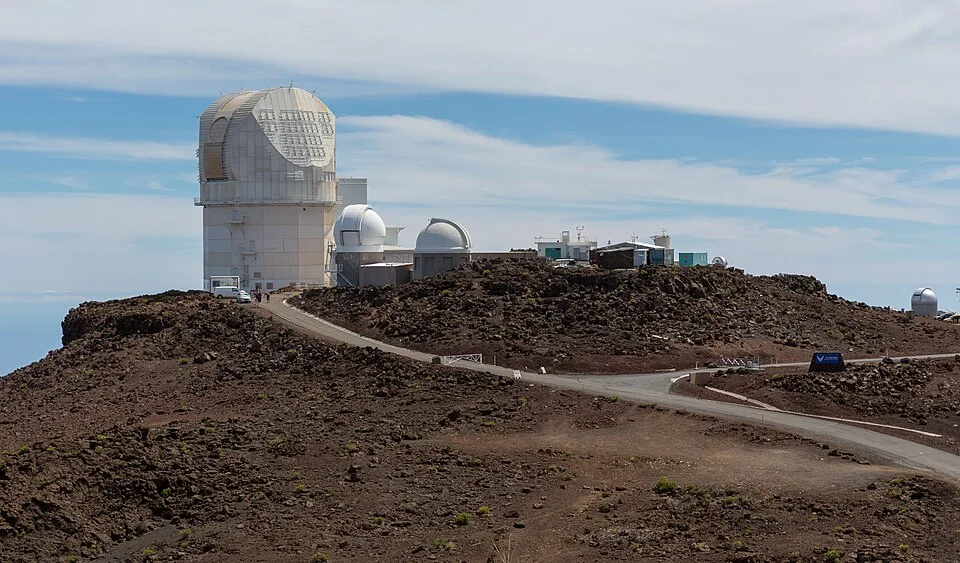
The work appeared in Nature on 5 August. An international team used the Daniel K. Inouye Solar Telescope on Maui to look closely at the photosphere, the layer we usually mean when we talk about the Sun’s visible surface. On 6 August NASA featured the imagery in its Astronomy Picture of the Day. The photographs show delicate streaks and folded edges, details that can disappear altogether when a telescope cannot distinguish neighbouring features.
A disturbance at the boundary
The phenomenon has a familiar counterpart on Earth. Two neighbouring streams of fluid can move at different speeds. Under the right conditions, a small disturbance along their boundary grows and rolls up. The formal name is Kelvin–Helmholtz instability. The Sun offers a particularly demanding place to identify it because the material moving there is electrically charged and magnetic fields influence what it does.
A resemblance to curling water would have made an interesting picture, but several physical processes can produce patterns that look alike. The team compared sequences of observations with a simulation grounded in equations for the behaviour of the solar material and magnetic field. It examined where disturbances formed, how they evolved and how far apart they were. Those measurements narrowed the possibilities in a way a single attractive still could not.
The simulation also supplied a view the telescope did not directly measure. It showed how the sideways speed of material changed sharply at a magnetic boundary. That gave researchers a physical reason for the observed pattern to appear in that particular place. Agreement between an image and a simulation becomes more persuasive when the model can account for both the shape and the conditions required to produce it.
The next measurement
One possible consequence reaches beyond the photosphere. Motion at the surface can rearrange magnetic fields and move energy upward. Researchers want to establish how much these frequently occurring small swirls contribute to that transfer. Identifying them gives the question a firmer observational basis.
There is still a substantial distance between recognising a swirl and predicting a solar eruption. Such a prediction would require evidence about how energy travels, accumulates and is released across much larger regions. The achievement here is closer to the telescope itself. A pattern small enough to vanish in a coarser image can now be measured well enough to challenge a computer model.