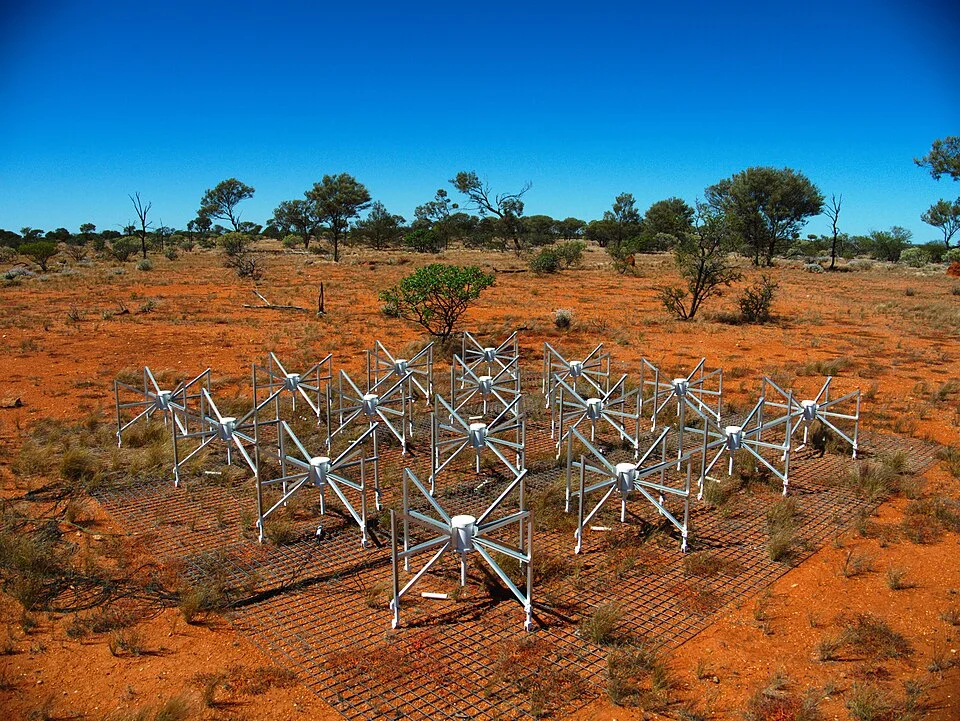
- The AAVS3 prototype tested a Vogel pattern with 256 antennas.
- Observations confirmed a sensitivity dip near 125 MHz for signals directly overhead.
- SKA-Low’s design calls for 512 stations of 256 antennas each.
Inside this story 2 perspectives
A sunflower packs its seeds efficiently enough to inspire a radio telescope. For the engineers building SKA-Low in Western Australia, the idea was to arrange antennas along a similar spiral so that neighbouring elements would sit farther apart. A prototype did reduce one source of interference. It also exposed another: at around 125 megahertz the station became less sensitive to signals arriving directly overhead.
The result was described on 24 September in coverage of research by Shin'ichiro Asayama and colleagues published in the Journal of Astronomical Telescopes, Instruments, and Systems. Their test station, AAVS3, contained 256 antennas and could operate as an imaging array or combine their signals into a single beam. Engineers put it to work on recognisable sources in the real sky, including the Sun, the plane of the Milky Way and pulsars.
Why rearrange the antennas?
SKA-Low is being built on the traditional lands of the Wajarri Yamaji in Western Australia's Murchison region. Its planned 512 stations each have 256 antennas. The antennas have no moving parts; computers combine their signals to make the telescope effectively look in a chosen direction. The useful frequency range stretches from 50 to 350 megahertz. The layout on the ground thus helps determine which signals astronomers will eventually be able to distinguish.
An earlier prototype distributed its antennas using a scattered, pseudo-random layout. The approach avoids some unwanted patterns in the signal, but antennas that sit close together can affect one another. The sunflower-inspired arrangement, known as a Vogel pattern, was an attempt to give adjacent antennas more room. A design can lessen the effect of near neighbours and still introduce a new difficulty if many more distant pairs repeat the same separation.
While the station was under construction, simulations identified a possible problem with repeated spacings of around 2.4 metres. Observations confirmed the loss in sensitivity when the galactic plane passed overhead at the frequency in question. That is a specific limitation at a particular frequency and direction. It would be misleading to describe the prototype as incapable of observing the sky above it across its whole operating range.
What a discarded layout contributes
The telescope project selected a different layout for the final instrument. The test also helped the team compare calibration methods. A reference based on the Sun worked in daylight. Combining solar information with a model of sky brightness and antenna responses provided a way to calibrate at night as well.
Replicate a minor layout error across a station and it may be possible to measure it. Replicate the same layout across hundreds of stations and it becomes part of the observatory. The prototype earned its place precisely because the engineers could change their minds while the choice was still theirs to make.