- Psyche began its near-continuous propulsion schedule on 28 September.
- It expels charged xenon atoms, using electricity generated by solar panels.
- The spacecraft must manage both declining sunlight and a small twisting force.
Inside this story 2 perspectives
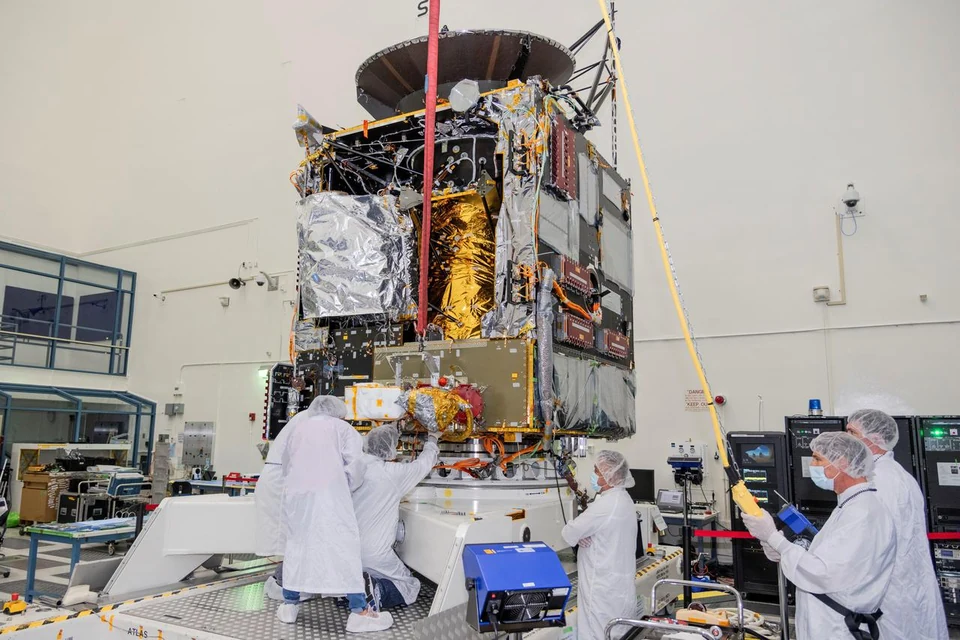
NASA’s Psyche spacecraft has four thrusters, but only one operates at a time. For most of the journey ahead there will be one running. In an update on 22 October, the mission team described a flight plan that calls for thrust during nearly 90% of the remaining cruise towards the metal-rich asteroid that shares the spacecraft’s name.
The change in routine began on 28 September, months after Psyche passed Mars for a gravitational assist. Under the new schedule it pauses for a weekly check-in with Earth. The aim is to arrive at the asteroid in 2029. The work between here and there involves keeping a very small force pointed in a useful direction for a remarkably long time.
The active engine can generate up to 250 millinewtons of thrust. A push that small would be easy to overlook in everyday life. In interplanetary space, it keeps adding to the spacecraft’s change in velocity. The relevant calculation includes both the force and the time for which it acts. A brief demonstration on a laboratory bench gives a poor sense of what years of operation can accomplish.
What the solar panels supply
Sunlight provides the electrical energy. Xenon provides the material that leaves the craft. The propulsion system charges xenon atoms and accelerates them out of the thruster. Momentum carried away in one direction gives the spacecraft a push in the other. The panels therefore solve a different problem from the onboard tanks, which started the mission holding around 1,090 kilograms of xenon.
NASA says the craft has used roughly a third of that supply in the three years since launch. The engines will also have work to do once the science mission begins at the asteroid. The team expects to reduce propulsion power gradually as the craft gets farther from the Sun, where the same area of solar panel receives less light.
The small twist the team can measure
A second effect complicates the job. The charged particles swirl as they leave the engine. The resulting twist is so slight that it is hard to appreciate in a short test. Over hours it matters to a craft that needs to point its instruments, antennas and engines accurately. Reaction wheels absorb angular momentum by changing the speed at which they spin.
Periodically the spacecraft interrupts the sequence, turns and uses a different thruster briefly to remove the accumulated momentum. The long journey is giving engineers a chance to measure that effect at different power levels over extended periods. The same engine system that will eventually place Psyche in orbit around an unfamiliar world is already yielding data about how to fly there.