- Young common octopuses used an extra stage of movement in tighter openings.
- Mayan octopuses in the experiments behaved differently.
- The work describes observed animal movement and a possible direction for robotics.
Inside this story 1 perspectives
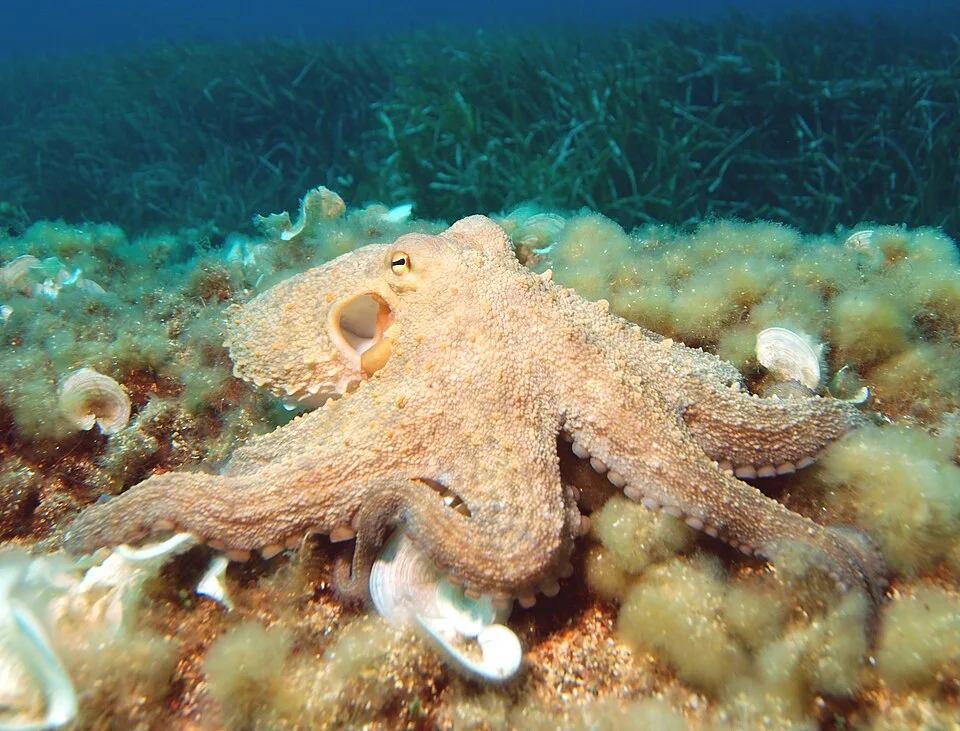
An octopus has a soft body, but softness alone does not tell it what to do with eight arms on the way through a small opening. A study reported on 5 November in the Journal of Experimental Biology asks a more exact question about a familiar feat. In what order does the animal move, and does it change that order when less room is available? Film of young octopuses negotiating openings gives the researchers a way to separate flexibility from the sequence of actions that makes it useful.
The experiment compared common octopuses and Mayan octopuses. The team used the distance between the eyes as a practical measure related to the firmer structures around the central nervous system. An opening that looks small to a person watching a video can be relatively spacious for one animal and demanding for another. Relating the size of the gap to each individual therefore matters more than quoting a single impressive hole size.
When the arms go first
At the more generous openings, the animals explored with their arms and sent one through, followed by several others. Arms that had already passed the partition could then grip and help bring the rest of the body along. The movement was organised around what individual arms could reach and where they could gain purchase. The image of an animal simply flowing through like a liquid misses the work being done by its muscles and suckers.
Common octopuses approached narrower openings differently. Space restricted how many arms could pass together, and the animals separated the final movement into two stages. They drew the remaining arms through before bringing the mantle after them. Changing the sequence allowed the same body to address a different constraint. More effort applied to an unchanged movement would not necessarily have achieved the same thing.
The Mayan octopuses in the study did not attempt the narrowest opening when it was the only option. When given a choice, they investigated the small opening before using a larger one. That observation sets a limit on how widely the result can be generalised. A refusal to pass does not by itself establish that an animal was physically incapable of doing so. Behaviour matters alongside anatomy.
The team is interested in what these movements could teach designers of soft robots for difficult environments. A flexible machine still requires a way to sense the restriction ahead, coordinate its parts and find a stable point from which to pull. The paper does not present a finished machine. Its contribution is to turn an apparently effortless animal performance into a number of observable decisions about contact, order and available space.