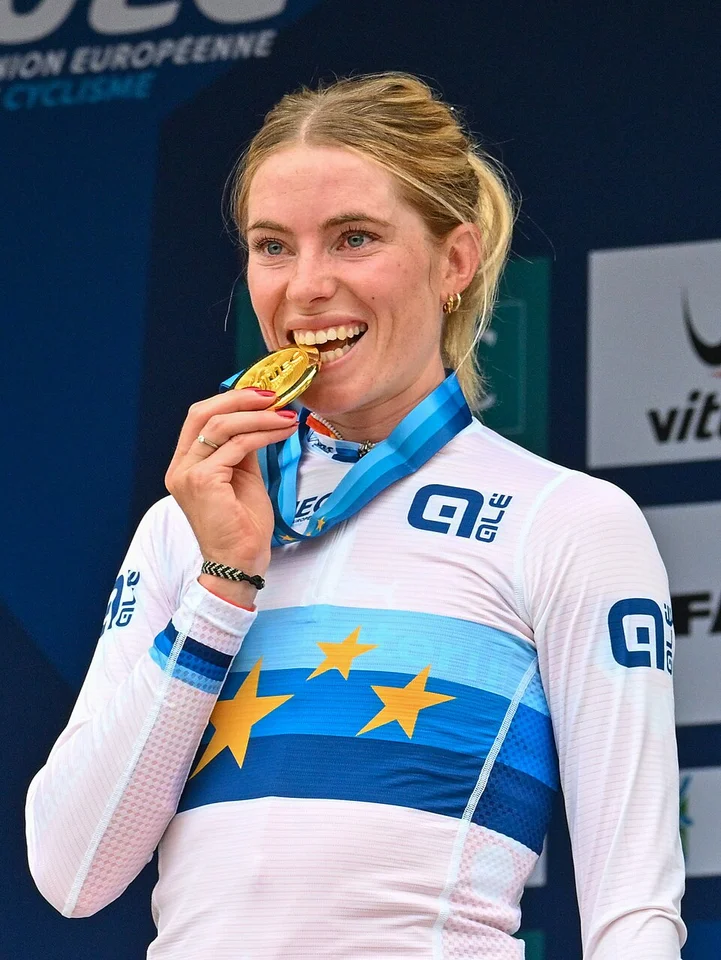
- Demi Vollering won the ninth stage and the overall title on 9 August.
- She attacked inside the final kilometre of the last ascent of the Col d’Èze.
- Katarzyna Niewiadoma-Phinney was second overall and Elisa Longo Borghini finished third.
Inside this story 2 perspectives
By the fourth time the riders went up the Col d’Èze, the route was familiar but the race had changed. The 2026 Tour de France Femmes was still separated by just eight seconds. Demi Vollering had the yellow jersey. Katarzyna Niewiadoma-Phinney had the strongest reason to make the last climb difficult. It was the rider in yellow who eventually broke free.
Vollering attacked about 800 metres short of the summit, increased her advantage on the descent and won the final stage in Nice on 9 August. It delivered the Dutch rider her second overall title. The final margin over Niewiadoma-Phinney was a minute and 18 seconds. Italy’s Elisa Longo Borghini took third, four minutes and 29 seconds behind the winner.
Why four laps made a difference
The last stage covered 99.2 kilometres. The riders repeatedly left the coast for the Col d’Èze before returning towards the Promenade des Anglais. A circuit gives spectators several looks at the same riders. It also gives them a way to see the cost of the preceding lap. A group that looked comfortable on the first ascent might be reduced to a handful the next time past.
Different races were being settled in that group. Switzerland’s Marlen Reusser started the day third overall. She was dropped on the climb and subsequently crashed on the descent. That opened a route to the podium for Longo Borghini. Canada’s Isabella Holmgren went ahead on the third climb and still had to be caught. A rider could therefore be helping decide third place, trying to win the stage or defending yellow, all on the same stretch of road.
The leader could afford to wait
Niewiadoma-Phinney had to take time from Vollering. Her teammate Antonia Niedermaier set a hard pace on the final ascent, and the Polish contender accelerated after Holmgren was caught. Vollering could follow as long as she was able. If the two reached the finish together, the rider already ahead had the advantage. The challenger had to make something happen before the road ran out.
When Vollering accelerated near the top, she gained about 15 seconds on her closest rival by the summit. Downhill, the separation grew. Niewiadoma-Phinney was caught by a group containing Longo Borghini, while Vollering arrived alone. The eight seconds that had given the leader breathing space at the bottom of the climb looked quite different on the far side.
Niedermaier, whose work helped launch the final challenge, took the white jersey as best young rider and finished fourth overall. Her result is a reminder for anyone watching a stage race for the first time. The person who gives up the front of the group may already have done the job that mattered.