- The London exhibition was inaugurated on 2 September and is scheduled to open to the public on 10 September.
- The work tells the story leading to the Norman Conquest in wool embroidered on linen.
- France loaned it during the renovation of its museum in Bayeux.
Inside this story 2 perspectives
Someone who already knows who wins the Battle of Hastings has a particular advantage when looking at the Bayeux Tapestry. There is less temptation to hurry to the end. The viewer has time for the people preparing for a crossing, the horses accompanying them and the creatures tucked into the borders of nearly seventy metres of embroidered linen.
On Wednesday, French President Emmanuel Macron joined King Charles III and Queen Camilla at the British Museum for the inauguration of the exhibition. The public opening is scheduled for 10 September. The work travelled from Normandy in July, when the closure of its museum in Bayeux for renovation made an exceptional loan possible. That interval between arrival and exhibition forms a small chapter in the history of an object nearly a thousand years old.
A story the length of a walk
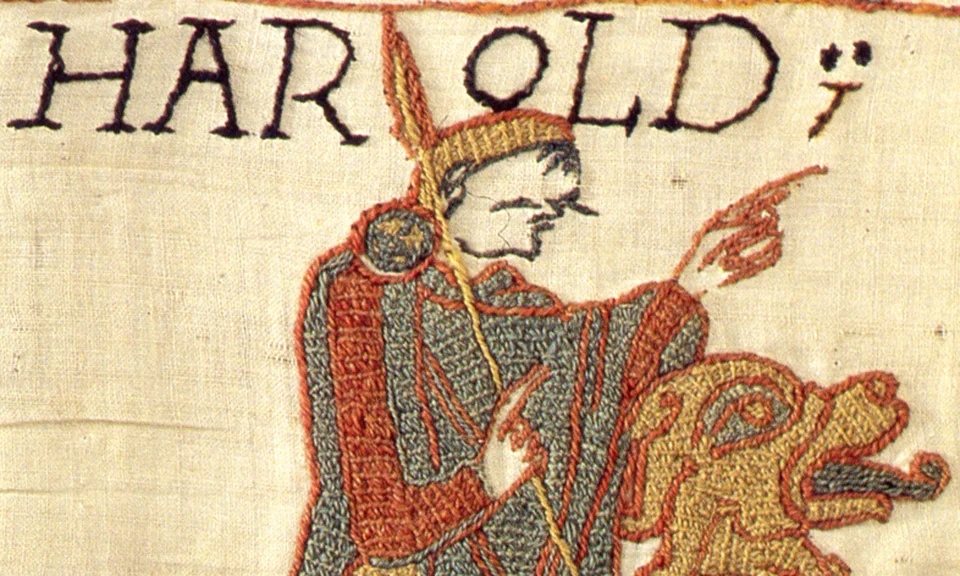
The embroidery follows the events leading to the Norman Conquest of England in 1066. Harold’s coronation and the fighting at Hastings are among the scenes curators pointed out during the London visit. The arrangement poses a simple physical problem for anyone looking closely. Step back and it becomes easier to see the flow from one group to another. Move nearer and the individual stitches, figures and small details begin to claim attention.
The word tapestry is a familiar name for the work. Its pictures were made by embroidering wool on a linen ground, so a horse, a ship and a human gesture all had to be translated into decisions about thread. A viewer can recognise a whole animal almost immediately. Taking another moment reveals the ingenuity required to do it with the materials available. The margins offer another route through the work, one that sometimes puts an animal ahead of a king in the viewer’s order of attention.
The crossing before the exhibition
The Institut français says the journey was prepared for over a year. The work travelled in a specially designed crate with control over temperature and vibration and had time to acclimatise before installation. Seen from the museum floor, a long stretch of apparently continuous narrative can make it easy to forget those practical requirements. Its safe passage depended on people thinking of the embroidery as a vulnerable physical object with an appointment in another country.
The loan brings British objects to museums in France in exchange. It has also brought a very old uncertainty back into view. As Macron acknowledged at the unveiling, the exact place where the work was embroidered is still a matter of discussion. An object that can provide so many details about a king, an army and its horses can remain curiously reticent about the people whose hands made them visible.