- The last Karatsu Kunchi procession took its scheduled place on 4 November.
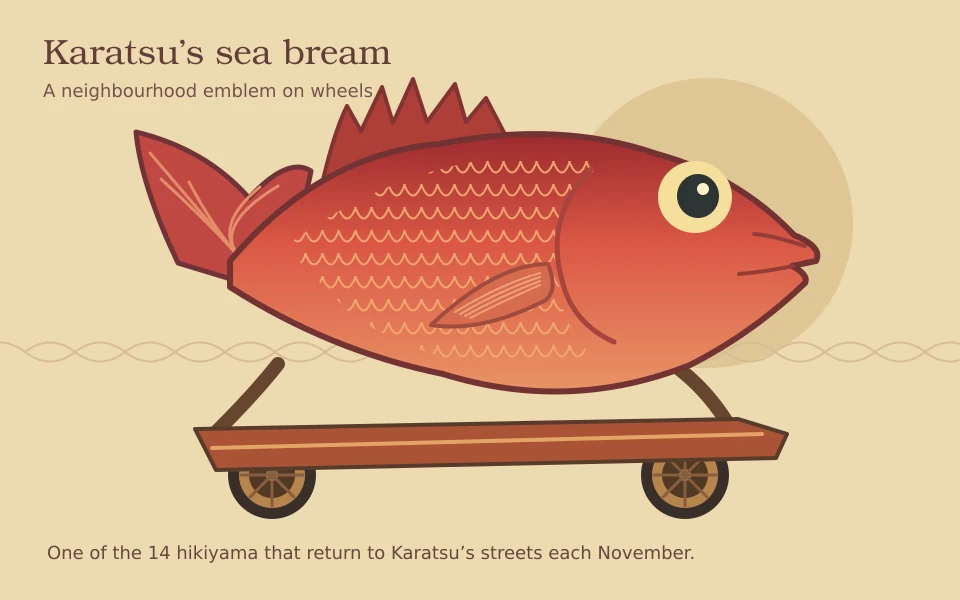
- Fourteen floats represent different neighbourhoods and carry distinct designs.
- The exhibition hall offers a way to see the floats outside the three festival days.
Inside this story 1 perspectives
A lion, a helmet and a sea creature can all belong to the same procession in Karatsu. Their unlikely company makes more sense once a visitor knows that each great lacquered float represents a neighbourhood of the old castle town in Saga Prefecture. On 4 November, the third and final day of Karatsu Kunchi, the programme gives these fourteen hikiyama another circuit through the streets. The portable shrine that accompanied the procession the previous day does not join them for this one.
Karatsu Tourism Association describes the final circuit as about eight kilometres. Participants from each district wear matching clothing and help bring their own float through the town, accompanied by musicians. A traveller who only sees a close photograph of a float may imagine a static piece of sculpture. Its public life also depends on people who know how to move it, keep its place in a sequence and take it back to the neighbourhood that cares for it.
A three-day change of perspective
The festival runs each year from 2 to 4 November as the autumn observance of Karatsu Shrine. The first evening brings out floats lit by lanterns. On 3 November they accompany the portable shrine towards the temporary festival grounds at Nishinohama. The tourism association describes a sequence beginning with the red lion of Katanamachi and following the age of the floats. There is a practical difference between watching them come together at night, seeing them drawn into the festival grounds and following their final passage through familiar streets.
The bodies of the floats also reward a closer look. Fukuoka Now describes layers of traditional washi paper and hemp cloth finished with lacquer. The scale and shape suggest monumental weight, yet the work of building up surfaces and finishing them is as much a part of the craft as the motifs the audience immediately recognises. A neighbourhood’s emblem must remain legible to spectators at a distance while holding the sort of detail that can only be seen nearby.
For visitors arriving after 4 November, the distinction between the object and the occasion has a useful consequence. The Japan National Tourism Organization points to the Hikiyama Exhibition Hall as a place to see the floats through the year. An exhibition cannot reproduce the noise, coordination and movement of a procession. It can offer time to compare the modelling of a creature with the construction of a helmet, or to discover why two objects that looked similar in a photograph belong to different districts.
Karatsu’s three days give the town a collective rhythm. After the final circuit, looking at one float at a time gives that collective a set of individual names, skills and neighbourhood histories.