- The 2026 physics prize recognised Francis Halzen’s contributions to IceCube and astrophysical neutrino discovery.
- The observatory began operations in 2011 and published its landmark findings in 2013.
- Its sensors detect light from secondary charged particles, allowing researchers to infer neutrino events.
Inside this story 2 perspectives
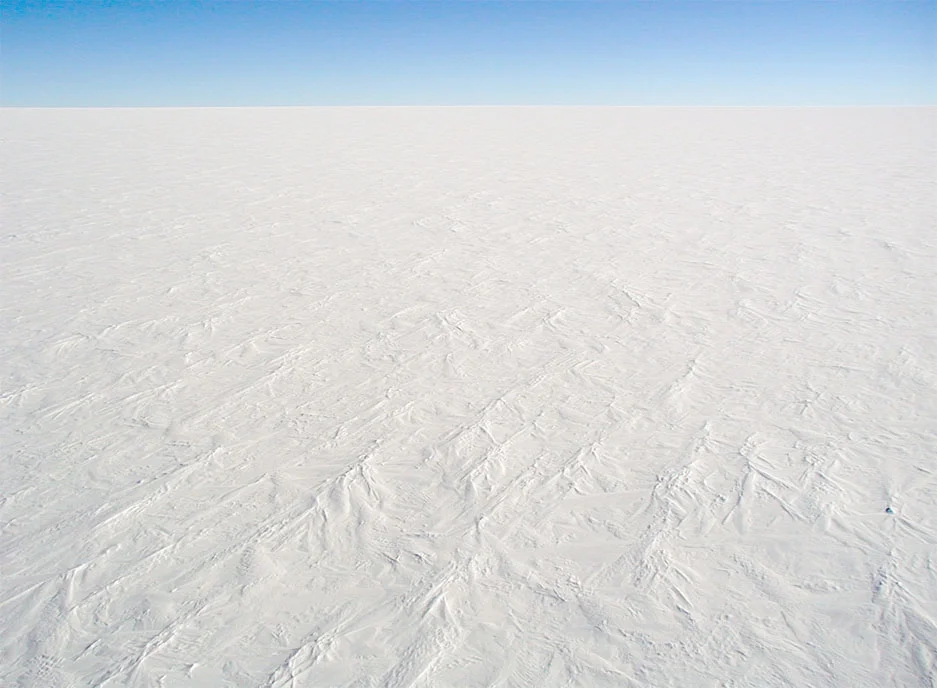
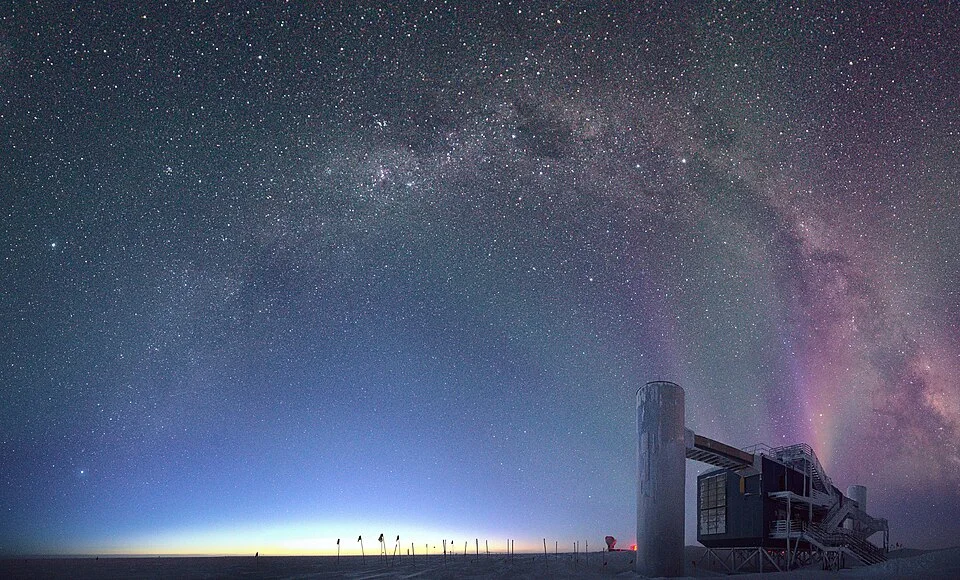
A telescope normally calls to mind a mirror pointed at the sky. The observatory recognised by the 2026 Nobel Prize in Physics places its light sensors below the surface of the South Pole. On 6 October, Francis Halzen received the award for his role in developing IceCube and establishing that high-energy neutrinos arrive from astrophysical sources. The Antarctic ice serves as part of the instrument.
Neutrinos are abundant particles that interact very weakly with matter. That property makes them valuable messengers from distant events and exceptionally difficult to detect. A neutrino can travel through an enormous amount of material without leaving a measurable sign. Building a useful observatory therefore requires an enormous volume in which to wait for the unusual interaction that does leave a trace.
Where the light comes from
Deep, clear ice performs two jobs. It provides matter in which a passing neutrino may interact and a medium through which light can travel to an array of sensors. Following an interaction, a charged particle moving through the ice can produce a faint flash known as Cherenkov light. The detectors register that light. Researchers use its pattern and arrival times at different sensors to reconstruct information about the original event.
The distinction matters to the way astronomers read the data. IceCube does not produce an ordinary image of a neutrino arriving from a distant galaxy. It collects a pattern of signals from which the team has to infer an energy and, with precision that depends on the event, a direction. Many events must be examined against background signals before researchers can make a claim about a population of cosmic particles.
A longer history than the prize announcement
The National Science Foundation traces the proposal back to the 1990s. Construction began in 2004 at the US Amundsen-Scott South Pole Station. IceCube began operations in 2011, and in 2013 the collaboration published evidence for high-energy neutrinos from beyond the Solar System. The succession of dates records several distinct accomplishments, from securing support for a difficult observatory to extracting a credible signal from its data.
The later science illustrates why the method matters. Researchers have used IceCube observations in investigations of individual distant sources and, in 2023, produced a picture of the Milky Way based on neutrinos. An optical picture traces light reaching a telescope. A neutrino picture traces directions and energies reconstructed from particle interactions. Comparing different kinds of evidence lets astronomers ask how energetic particles are produced in places no instrument can visit. Halzen’s prize recognises the idea that one such instrument could be made with part of Antarctica itself.