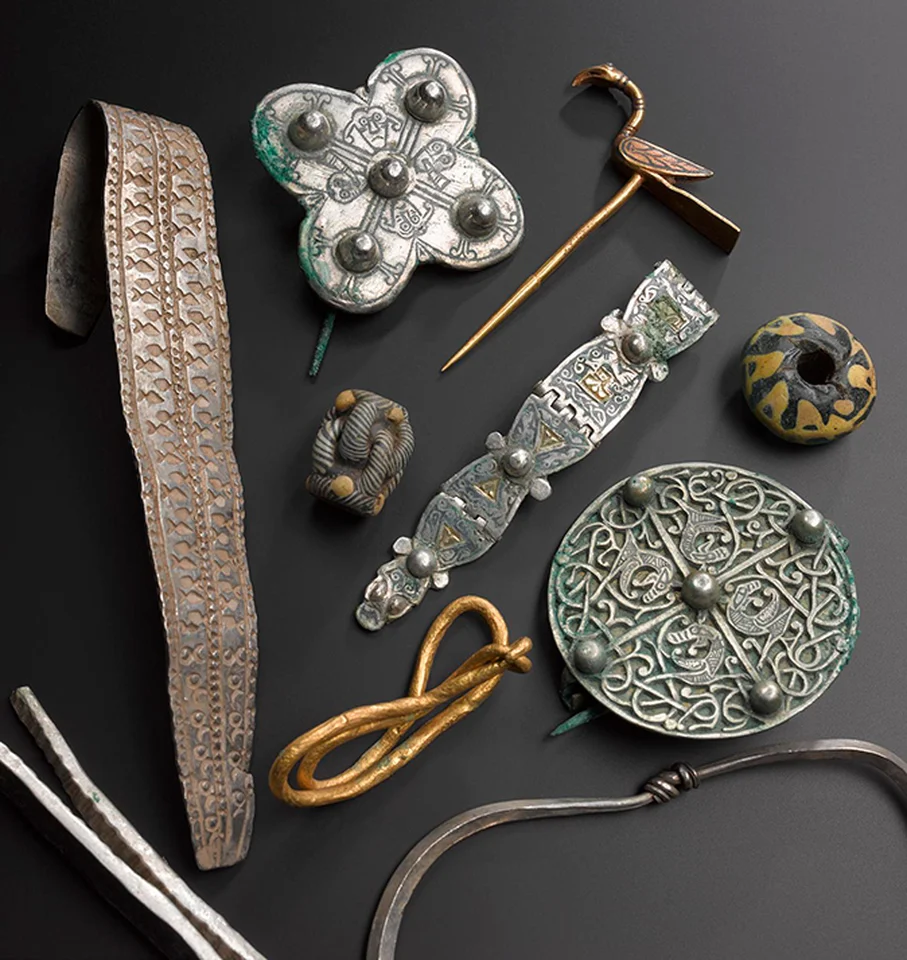
- The hoard was buried around AD 900 and discovered in Scotland in 2014.
- Careful burial helped preserve rare organic textiles.
- Sydney’s August weekend programme includes storytelling and craft demonstrations.
Inside this story 2 perspectives
More than five kilograms of silver, gold and other materials would be enough to draw attention to a buried hoard. In the Galloway Hoard, however, some of the most intriguing evidence weighs almost nothing. Protective wrapping helped preserve fragments of silk and other textiles for more than a thousand years. The Australian National Maritime Museum’s current exhibition in Sydney makes room for those remains beside the more eye-catching metalwork.
The hoard was buried around AD 900 in what is now south-west Scotland and found by metal detectorists in 2014. The museum is displaying more than 90 objects from the collection. Its August programme adds weekend storytelling, craft demonstrations and guided visits to the exhibition. For visitors arriving with an image of a single Viking owner clutching a chest of coins, there are good reasons to look again.
A wrapping is a decision
An archaeologist can learn from where an object came to rest, what lay beside it and what somebody chose to wrap around it. A brooch considered alone can suggest a way of dressing or a craft technique. The same brooch found carefully bundled with other possessions raises further questions about value, protection and the circumstances in which the bundle was assembled.
Metal and cloth have very different chances of surviving underground. The richness of a modern display can therefore create a false impression of what people valued. We can still see and weigh the silver. Ordinary textiles that mattered enormously to the people who made and used them may have vanished. The rare survivors in this collection let researchers ask a question that a display of metal alone could conceal.
Objects in the hoard have connections to Britain and Ireland, continental Europe and as far away as Central Asia. That range shows the distances materials and goods could travel during the early medieval period. It does not establish that a single person made the journey from one end of the chain to the other. Objects can pass through many hands as gifts, purchases, heirlooms or exchanges, acquiring new significance along the way.
How to look at a cleaned object
Since 2017, National Museums Scotland’s conservation and research work has uncovered decoration and inscriptions that were difficult or impossible to see before. Such work changes what can reasonably be said about an object. It can reveal a mark a maker left or a detail that helps identify a form. It rarely supplies a complete account of who used it every day or why it finally went into the ground.
That unresolved history makes the Sydney programme’s demonstrations worth viewing alongside the cases. Watching the movements required to make or decorate an object encourages a visitor to think about labour as well as wealth. A tiny piece of silk can then take its place beside a silver bracelet as evidence of skill, distance and somebody’s decision to keep both.