- FinDev Canada, British International Investment and Norfund signed a cooperation agreement at COP31.
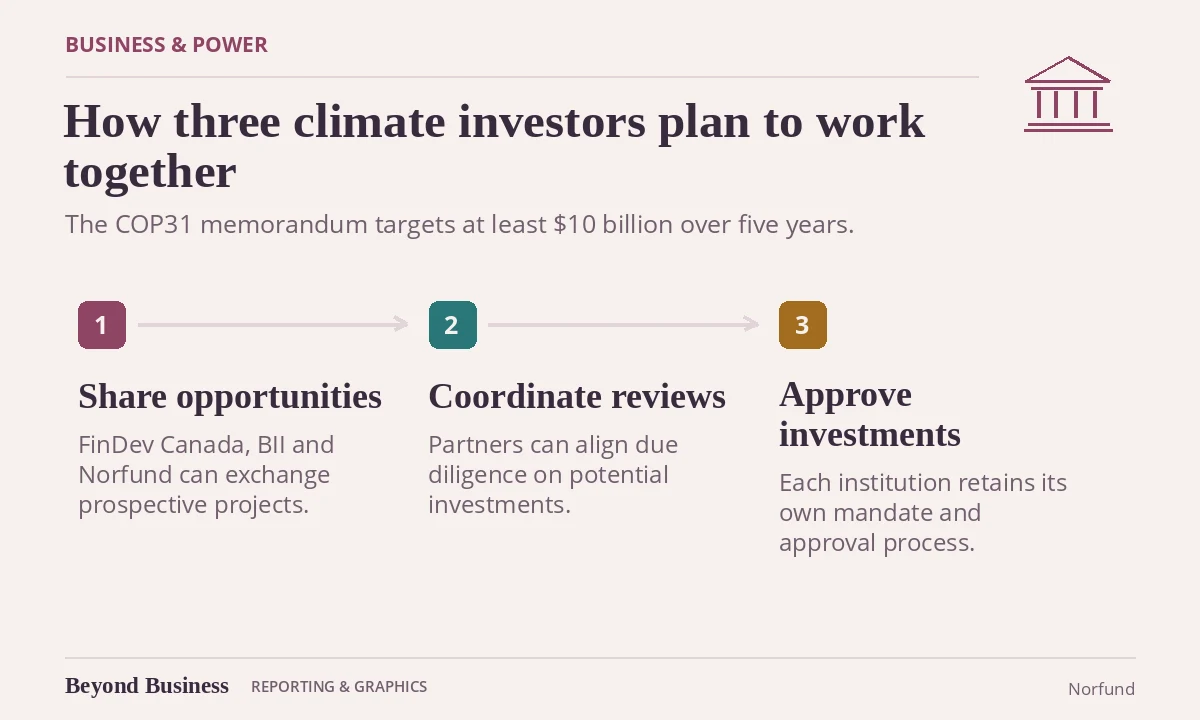
- Their strategies aim to support at least US$10 billion in climate and energy-transition investment activity over five years.
- The memorandum creates no new financial commitment or joint investment fund.
Inside this story 2 perspectives
A large climate-finance headline can create an immediate impression of money waiting to be claimed. The agreement announced at COP31 in Antalya deserves a closer reading.
On 13 November, FinDev Canada, British International Investment and Norfund signed a memorandum to coordinate work on climate and energy-transition investment. FinDev says their strategies are expected to support at least US$10 billion in investment activity over five years, including the mobilisation of private capital.
The institutions intend to share opportunities and coordinate due diligence and potential co-investments. Areas of interest include renewable power, electricity networks, storage, sustainable fuels and industrial decarbonisation.
Ambition still has to become an investment
The memorandum explicitly creates no joint platform, legal entity or financial commitment. Each institution retains its own mandate and approval process. It is therefore inaccurate to describe the announcement as a new US$10 billion grant fund available to applicants.
For an African energy developer or an industrial business planning a transition project, the useful signal is institutional interest in turning a pipeline into transactions. Interest is an opening for preparation, not a financing guarantee.
Make the project easier to assess
Our reading is that the most productive response is to strengthen the underlying proposition: the customer need, expected revenues, delivery responsibilities and evidence behind the climate benefit. Unresolved land, grid or contracting assumptions should be visible before a funding conversation begins.
A compelling pitch explains why a project matters. An investable proposition also explains how it can be delivered, what could go wrong and who carries each risk. That is where a global announcement becomes relevant to an individual business.