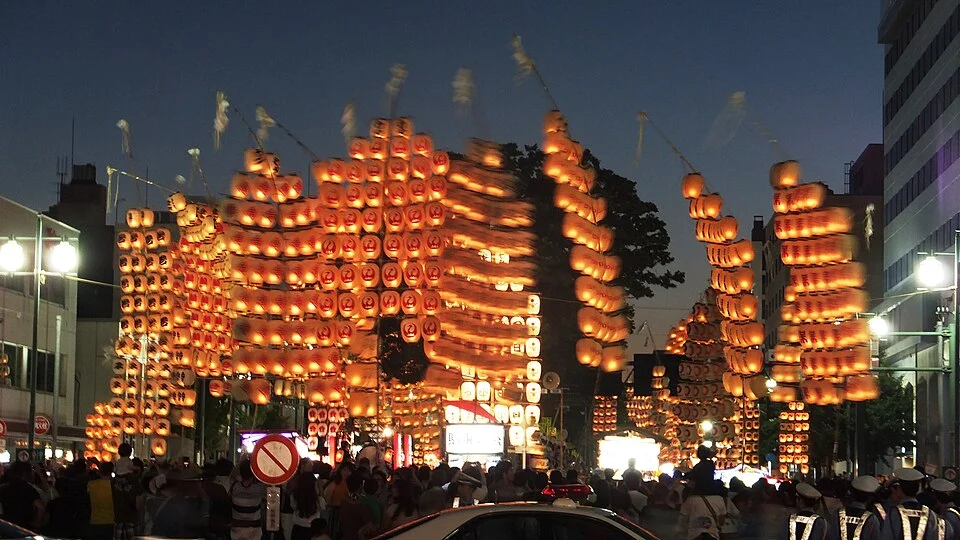
- Akita’s Kanto festival runs from 3 to 6 August, with night performances and daytime events.
- The largest standard pole is 12 metres long and carries 46 paper lanterns.
- The shape evokes a heavy ear of rice, reflecting the festival’s connection to hopes for a good harvest.
Inside this story 2 perspectives
The most striking object at Akita’s Kanto festival is a bamboo pole hung with rows of glowing paper lanterns. The most revealing place to look is the point where the bamboo meets a performer’s body. A pole can rest on an open palm, a shoulder, a hip or even a forehead. The light overhead makes a beautiful photograph. It is the transfer between those positions that shows how much work the picture contains.
On 5 August, the four-day festival in northern Japan offers a visitor two opportunities to understand that skill. There is the night parade along Kanto Odori in the centre of Akita, and there are daytime competitions where individual techniques can be followed at closer range. A trip planned around the evening alone misses part of the event that makes the lights possible.
What a pole has to do with rice
The organiser’s largest standard pole, called an owaka, measures 12 metres and weighs about 50 kilograms with 46 lanterns. The lanterns hang from crosspieces attached to a single long stem. Look at the whole arrangement from a little distance and it resembles an ear of rice bowed under the weight of its grain. People in Akita use it to express hopes for a plentiful harvest.
There are smaller poles as well, and the performers take turns during the display. Extensions added to the bamboo increase its height. A visitor can first follow the outline against the sky, then pick one team and watch what happens when the next performer steps in. Drums and flutes accompany a feat that looks quite different from street level than it does in the familiar wide photograph of the parade.
Where to stand, and when to go
The main stretch of roadway is nearly a kilometre long. Reserved seating occupies the median, while viewers can also watch from the sides. The route is about a 15-minute walk from JR Akita Station. A traveller choosing a position has a real trade-off. Looking along the procession gives a sense of the crowd of lanterns. Standing nearer one team makes it easier to observe palms, shoulders and the next handover.
The daytime programme around the Akita Museum of Art includes competitions during the final three days. Spectators can see performers judged in individual and group categories. Smaller demonstration poles are available at other daytime activities. For a family with only one evening in town, that earlier visit changes the question a child might ask when the first lanterns go up. Counting them is easy. Working out how one person keeps them there takes watching.