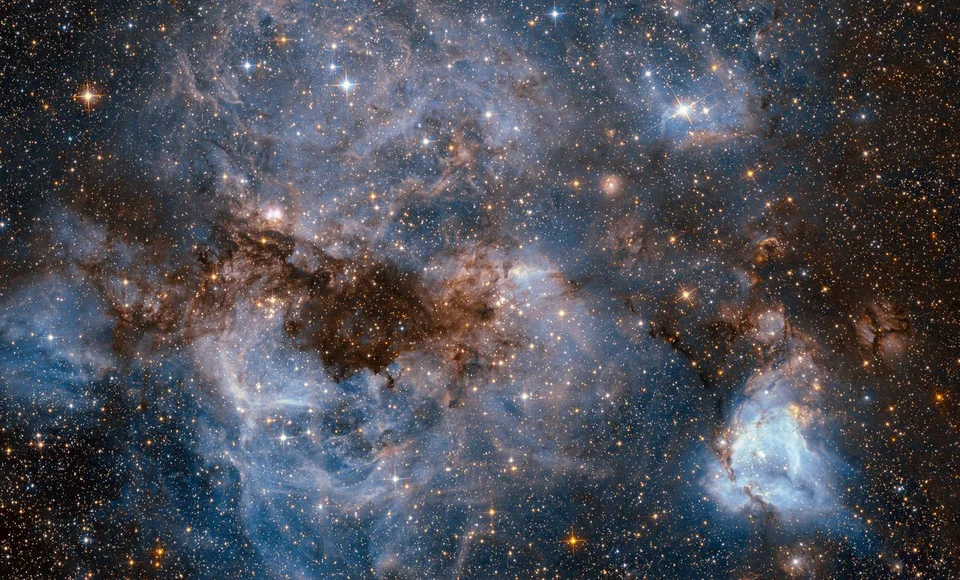
- ESA released the Webb image on 22 October as its October picture of the month.
- N159 is a region of star formation roughly 161,000 light-years away in the Large Magellanic Cloud.
- Dense molecular gas can shelter young stars while radiation from massive neighbours lights the more exposed gas.
Inside this story 2 perspectives
A cloud of hydrogen can be a cold place where gravity builds a new star or a bright region lit by a star that has already formed. The James Webb Space Telescope’s October picture of the month, released on 22 October, puts both conditions into one frame. The object is N159, a stellar nursery roughly 161,000 light-years away in the Large Magellanic Cloud, a satellite galaxy of the Milky Way.
The field spans about 230 light-years. A human observer could not stand outside it and see the scene in the colours used in the release. Webb’s Near-Infrared Camera records light beyond the visible spectrum through different filters. Assigning visible colours to those measurements lets astronomers distinguish features that would otherwise be difficult to separate in one picture.
Read the pale pools first
The pale blue areas pick out ionised hydrogen. Massive, hot stars give off ultraviolet light energetic enough to strip electrons from the surrounding gas. The result is what astronomers call an H II region, an indicator that active star formation has taken place nearby. The gas glows, making the influence of stars visible far beyond their immediate surroundings.
Those stars also produce strong winds that carve cavities and shape ridges in the surrounding cloud. A hollow-looking area in an image can therefore provide information about stars as well as about the gas. Its boundary marks a change in the material through which the light travels. It does not identify the date on which the cavity formed, or disclose the entire sequence of events that created the border visible today.
Then look for what survives in the ridges
Dark red filaments cross the central part of the image. ESA identifies them with cool molecular hydrogen, material in a different physical state from the ionised gas nearby. Dense gas can provide cover from the radiation and winds that make the adjoining cavities so conspicuous. Embedded points of light in some filaments and small pillars disclose stars within these more sheltered parts of the nebula.
Orange features supply yet another clue. They trace infrared emission from carbon-based molecules called polycyclic aromatic hydrocarbons. Assigning a colour to this emission helps a viewer follow where it lies relative to the molecular filaments and the exposed ionised gas. The contrast between these regions is more informative than trying to judge a star’s age from the brightness of a single point. Across the same image, stars are taking shape, emerging from dense material and changing the surroundings in which their neighbours will form.