- Eight qualifying teams competed for two main-draw places.
- Through the semifinals, sets go to four with a tiebreak at four-all.
- The final uses sets to six but keeps no-ad scoring and a deciding match tiebreak.
Inside this story 2 perspectives
A spectator arriving for US Open mixed doubles this week could have looked at a 4–4 score and expected several more service games. Through the semifinals, the players would instead be preparing to start a tiebreak. The championship, scheduled for 24 to 26 August before the main singles tournament, compresses Grand Slam tennis into a format with less room to recover from a poor stretch of play.
The route into the event is compressed too. For 2026, the US Tennis Association added an eight-team qualifying competition on 24 August for two places in the main draw. Six main-draw teams could enter directly through their combined singles rankings, with eight wild cards completing the 16-team field. A doubles specialist and a prominent singles pairing can therefore arrive on the same court after very different routes to acceptance.
What changes at deuce?
Regular advantage scoring asks a team to win two successive points from deuce to take the game. Under the mixed event’s no-ad format, one deciding point ends the game. A pair can save a succession of difficult service games in a conventional match. Here there is one decision about the serve, one return and one immediate change to the scoreboard.
A similar compression takes place at the level of the set. Until the final, the teams play sets to four games, with a tiebreak at four-all. If the teams split the first two sets, a ten-point match tiebreak replaces a complete third set. The final uses sets to six games and a tiebreak at six-all, while retaining no-ad games and the ten-point decider instead of a full third set. Those details make it worth checking which round is on the television before trying to read the score.
For spectators the format changes the cost of looking away. A pair leading 3–2 in an early round is already close to the set. A single return game can decide it. For players, spending the opening games learning a new partner’s instincts takes up a larger share of the contest than it would in a longer match.
Why put it before the singles draw?
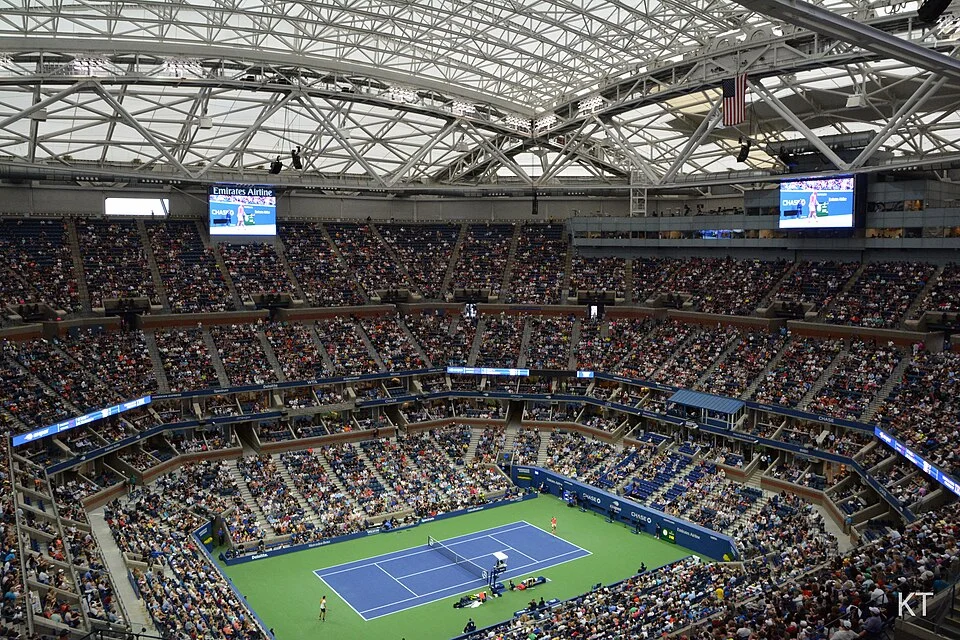
The organisers have placed the championship in Fan Week. Their published schedule included free-to-attend play on designated courts on Monday and Tuesday, alongside ticketed action in Arthur Ashe Stadium. Qualifying, wild cards and a compact draw give the event an identity of its own during the days when singles players are preparing to start the tournament.
That identity depends on the partnership as much as the list of stars. A returner still has to decide when to move across a partner at the net. A good serve gives the other player a chance to end the point. Under the short-set rules, a handful of good choices together can carry a team a surprisingly long way.