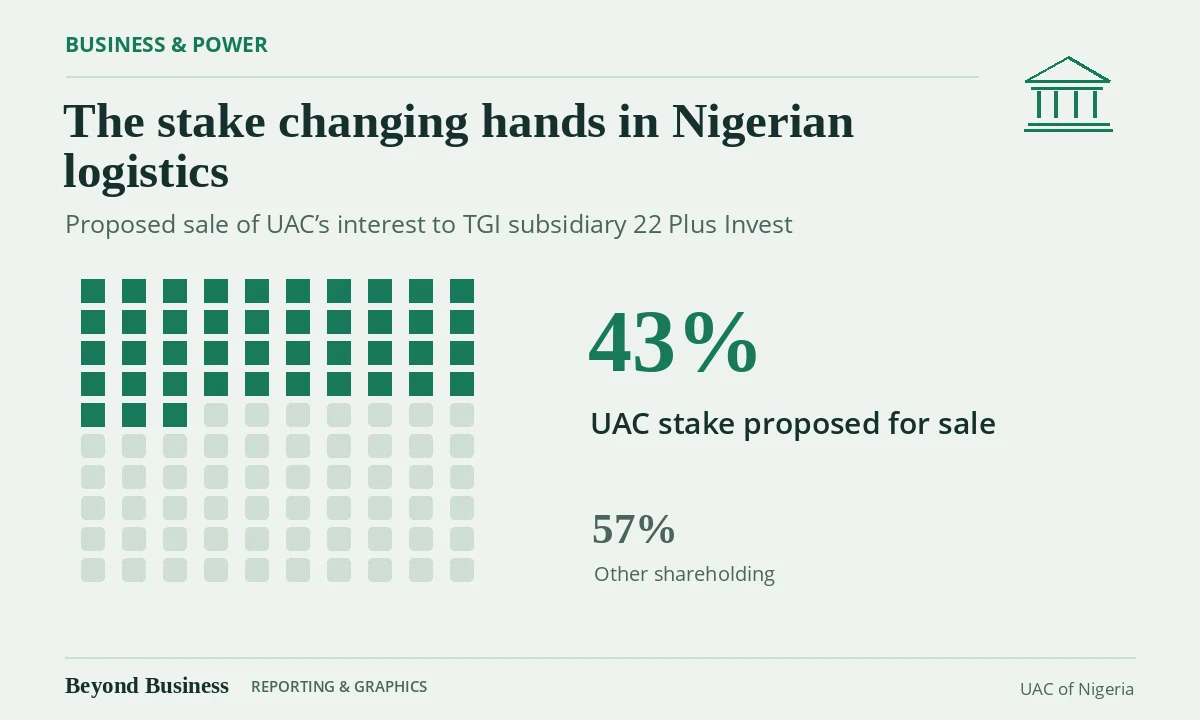
- UAC filed the proposed disposal with the Nigerian Exchange on 24 September.
- TGI subsidiary 22 Plus Invest Limited would acquire UAC’s entire 43% interest.
- The transaction requires regulatory approval and would leave DP World as majority owner.
Inside this story 2 perspectives
Nigerian shoppers encounter Tropical General Investments through the goods it produces and distributes. The group now wants an interest in the company that can take goods from a warehouse to their next customer. UAC of Nigeria disclosed on 24 September that it had agreed to sell its entire 43% stake in DP World Logistics Limited to a TGI group company. The Guardian’s 29 September account places that purchase alongside a much larger port proposal. The smaller transaction has its own commercial logic.
The legal buyer is 22 Plus Invest Limited. The business whose shares it would acquire was formerly known as MDS Logistics Limited. If regulators approve the deal, UAC will leave its shareholding and DP World will retain its majority interest. No portion of a new seaport changes hands under those terms. Nor does an agreement to buy existing shares tell readers that an equivalent sum will become available for new warehouses or trucks.
A customer’s view of a distribution business
A company that makes and sells goods sees a supply chain through the condition of the package that arrives, the order that turns up late or the space that goes unused on a return journey. Those are familiar problems for a carrier too, but the two sides often hold different pieces of information. The producer knows which goods need to reach its distributors next week. The carrier knows which routes and vehicles have room.
TGI has businesses in food processing, manufacturing and distribution, among other activities. Its stated case for the partnership is to combine local market knowledge and distribution reach with DP World’s logistics experience. The opportunity is easy to imagine in a particular order. With better information about timing and destinations, a dispatcher can decide whether two consignments can share a route. The published agreement gives no measure of how often such savings will occur.
Who owns the capacity, and who can use it?
An equity interest can give a producer a reason to invest time in solving those coordination problems. The logistics operator also has other customers. They will judge the value of the partnership by their own experience, including whether promised delivery windows are met and whether there is capacity when competing companies need it. A change in the shareholder register does little on its own to answer either question.
The first observable test is more prosaic than a freight forecast. Is the transaction approved and completed on its announced terms? After that, customers and shareholders can look for changes in services, delivery performance or operating results. For the moment the agreement identifies a prospective owner with its own goods to move, and an established logistics business in which it would still be a minority shareholder.