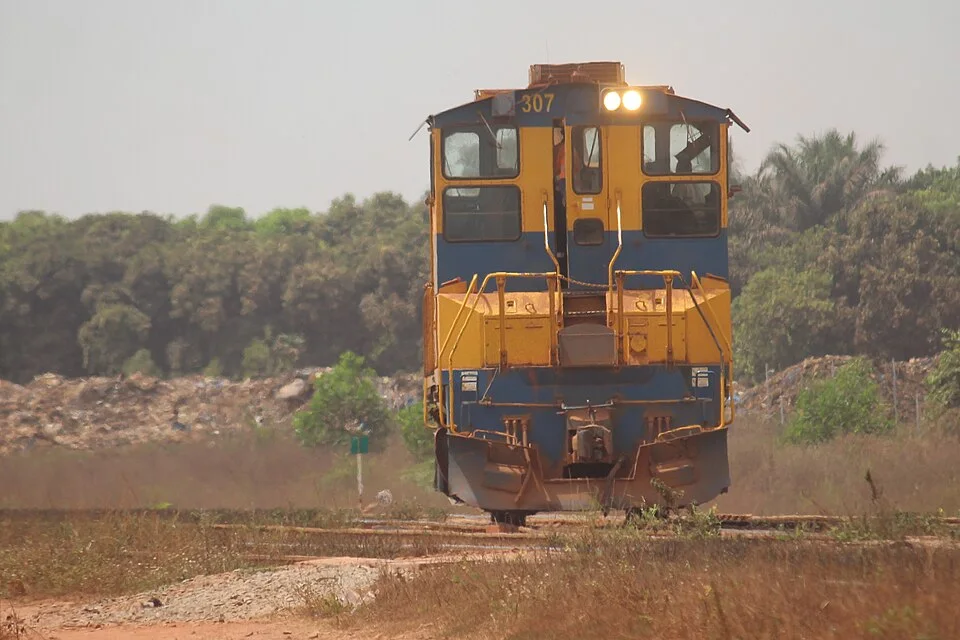
- The Congolese state and Mota-Engil Africa signed the concession in Kinshasa on 26 August.
- The roughly 1,004-kilometre section connects the southern mining belt to the line into Angola.
- The concession runs for 30 years and includes rehabilitation, operation and maintenance.
Inside this story 2 perspectives
A mine in the southern Democratic Republic of Congo can lie much closer to the Atlantic on a map than its commercial arrangements would suggest. An ore cargo goes where there is a dependable combination of wagons, border clearance, port capacity and a ship. On 26 August, in Kinshasa, the Congolese state signed a concession with Mota-Engil Africa aimed at making a westward journey through Angola a more practical choice.
The agreement covers roughly 1,004 kilometres of railway between Dilolo, on the Angolan frontier, and Sakania, in the south of Haut-Katanga near Zambia. The presidents of Congo and Angola attended the signing. For a business choosing a freight route, the distinctive feature of the agreement is its duration. The company is taking on the rehabilitation, operation and upkeep of the line over 30 years.
What a concession buys
Rail freight requires decisions with quite different clocks. Track improvements can be useful for decades. A broken wagon needs attention before the next train. A mine may commit tonnage in advance, while the buyer at the other end wants to know when a particular shipment will reach a vessel. Putting the work of restoring and running a line in the same agreement gives the operator a stake in the condition of the railway it will subsequently use.
The signature creates that responsibility. It does not tell an exporter how often a train will run, what a wagon will cost, or whether its customer’s delivery date can be met. Evidence of those things will come from the service. An attractive headline rate would count for little if a missed connection left a cargo waiting at the border or the port.
Where a second route has value
The wider Lobito Corridor links the Congolese mining belt to Angola’s Atlantic coast. S&P Global identifies Durban, Dar es Salaam and Beira as competing outlets for regional mineral traffic. Different destinations, shipping schedules and customer contracts can favour different ports. A westward route looks particularly interesting for buyers on the Atlantic, although the length of the rail journey is only one part of the calculation.
For Congo, a usable alternative could matter even for cargoes that keep taking their established route. A producer with two workable quotations can compare service and negotiate terms. Having two lines on a map offers considerably less bargaining power if only one has wagons available on the required date. The next test of the agreement will therefore come in small, observable units. For a mine that needs to make a sailing, the useful measure is the loaded train that arrives when the timetable says it will.