- Headline Japanese consumer prices rose 2.1% in September from a year earlier.
- Inflation excluding fresh food rose to 2.1% from 1.7% in August.
- The measure excluding both fresh food and energy reached 2.4%.
Inside this story 1 perspectives
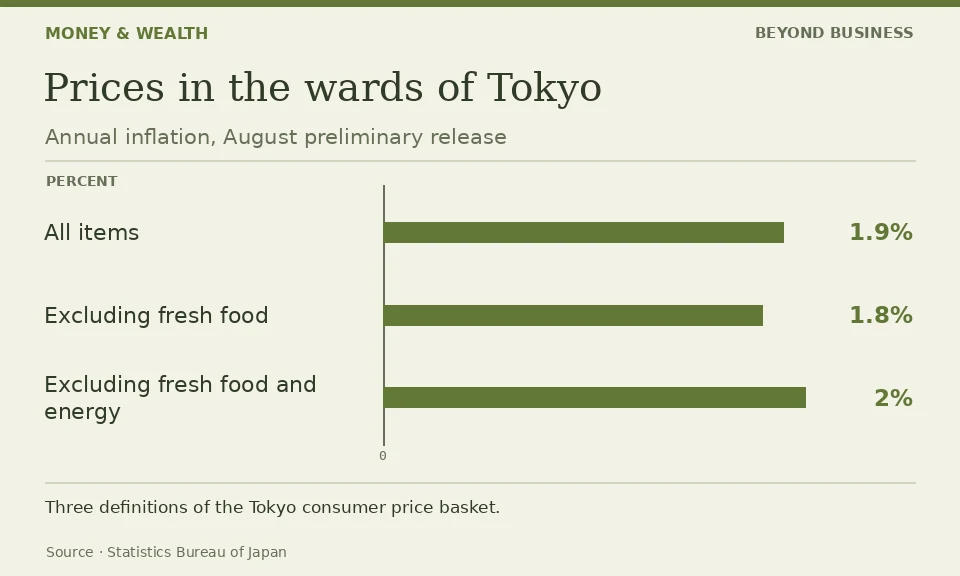
Two of the inflation numbers Japan published on 23 October were identical. Consumer prices overall were 2.1% higher in September than a year earlier. The index that excludes fresh food also rose 2.1%. A third measure, which takes both fresh food and energy out of the calculation, rose faster, by 2.4%. The figures look like rival answers only until the reader asks which part of household spending each is intended to describe.
The headline measure covers the broad basket. Fresh food prices can move sharply for reasons that make it difficult to judge the wider direction of prices, which is why Japan follows a measure that excludes them. Unlike some measures described as core inflation elsewhere, this one still includes fuel. In August the Japanese index excluding fresh food had risen 1.7% from a year earlier. September’s 2.1% was the first reading above the Bank of Japan’s 2% target in nine months, according to Reuters.
Why an exclusion can make the figure rise
It may seem odd that removing energy leaves a higher inflation rate. The explanation is that removing an item does not always remove the fastest increase. If a category rises more slowly than the remainder of the basket, or costs less than a year ago, including it can hold the overall rate down. CME’s analysis notes that Japanese subsidies for fuels and utilities have helped to keep energy prices below year-earlier levels even as energy and transport costs have put pressure on businesses.
The index excluding fresh food and energy rose 2.4%, compared with 1.9% in August. That result matters to someone looking for price pressure beyond the items that can show large temporary movements. The broader index matters to a person paying for those items. There is no need to choose one figure as the uniquely accurate description. A household with unusually high transport or utility costs may see a different pattern from a household spending more of its income elsewhere.
There is another easily missed distinction. A rise of 2.1% from September last year is a comparison between two months a year apart. It says nothing on its own about how much prices moved between August and September this year. Subtracting the two annual percentage rates gives the change in the reported rate, not the change in a family’s bill over one month.
The Bank of Japan raised its policy rate to 1.25% in September. The October figures give policymakers more evidence about how widely inflation is spreading, but they do not announce another interest-rate decision. For now they give readers three ways to examine the same economy. The best starting point is to read the description of the basket before drawing a conclusion from its number.