- The Thomson problem asks how repelling charges can minimise their energy on a sphere.
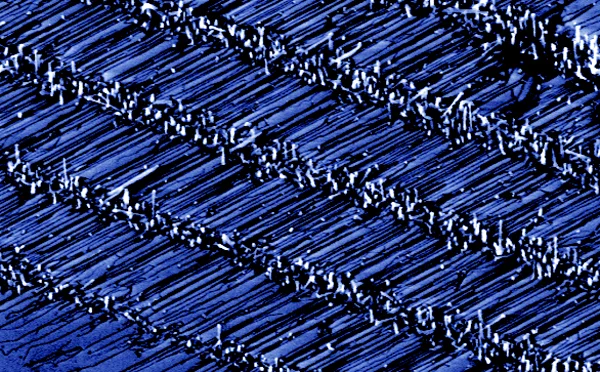
- Gold nanoparticles left patterns that could be imaged after the helium evaporated.
- Configurations with up to 36 charges closely matched theoretical predictions in the study.
Inside this story 2 perspectives
Put two identical electrical charges on a sphere, let each repel the other, and it is easy to guess where they will finish. The greatest possible separation lies at opposite ends of a diameter. Add many more charges and moving one farther from a neighbour tends to bring it closer to somebody else. Finding the arrangement with the least total energy becomes a much harder problem.
More than a century after J. J. Thomson posed the question in 1904, physicists have found a way to look at some answers in the laboratory. A collaboration involving the universities of Innsbruck, Leicester and Cambridge reports the work in Physical Review Letters. Its spherical surface is a droplet of superfluid helium. The visible record consists of gold particles left behind after that surface has vanished.
How to keep a disappearing pattern
Helium droplets provide an exceptionally cold environment in which the charges can arrange themselves close to the surface. The researchers used singly charged gold nanoparticles as markers. When a droplet landed on a grid for a transmission electron microscope, the helium evaporated and the particles left an imprint that could be examined.
This gives the original question an experimental partner. A computer can propose an arrangement on a sphere and calculate its energy. The microscope produces a flat record of a physical arrangement. Researchers can compare the imprint with how a proposed three-dimensional pattern would appear when deposited. Agreement between the two is evidence that the physical system found the expected configuration. A mismatch would be worth investigating too, because an arrangement can be stable enough to observe even if another one has lower energy.
The trouble with covering a sphere
With as many as 36 charges, the observed arrangements closely matched the lowest-energy configurations predicted by theory. At larger numbers, local patches displayed sixfold order, interrupted by sites with fivefold coordination. It helps to picture a flat sheet of hexagonal mesh. A small piece will sit fairly comfortably against a large ball. Extending the same perfectly regular neighbourhood around the entire ball is a different geometrical demand.
The experiment gives scientists a way to study where such interruptions appear and how larger groups of charges organise around them. The original problem outlived the historical model of the atom that prompted it because the geometry makes sense in its own right. Even these striking imprints leave open the mathematical question of how to find the best arrangement for an arbitrary number of charges. They give mathematicians and physicists something concrete to compare with the next candidate answer, drawn point by point by the particles themselves.