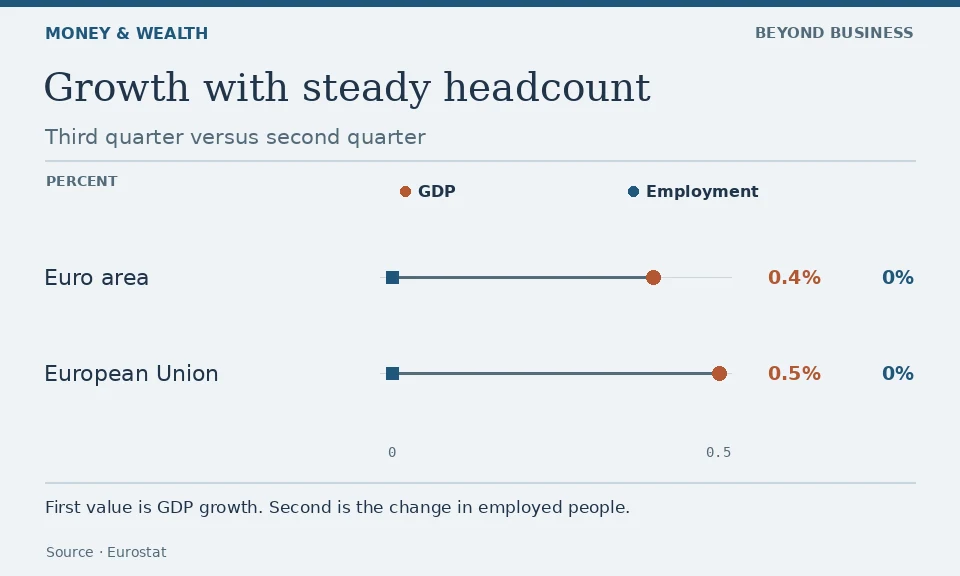
- Euro-area GDP rose 0.4% in the third quarter on a seasonally adjusted basis.
- The number of employed people was unchanged quarter on quarter.
- Measuring output per hour requires data on hours worked.
Inside this story 2 perspectives
A restaurant sells more lunches over the summer with the same number of names on its payroll. Did its workers get more productive? Perhaps the kitchen found a quicker way to serve the midday queue. Perhaps the staff worked longer shifts. A third possibility is that customers chose more expensive meals. Before rewarding or worrying about the kitchen, its owner would want to know which explanation is right.
On 13 November, Eurostat reported a version of that puzzle on the scale of the euro area. Its flash estimate showed seasonally adjusted economic output rising 0.4% in the third quarter, while the number of people in employment stayed flat compared with the previous quarter. Across the European Union, output grew 0.5% and employment also held steady. The growth figures measure the volume of economic output, removing the direct effect of price changes. The count of employed people still leaves several questions unanswered.
A person and an hour are different units
The OECD measures output per hour of work by dividing gross domestic product by hours worked. A person who works one extra shift appears once in the employment count on both sides of the comparison. The extra hours show up elsewhere. Employment can be stable while total hours rise, just as it can be stable when businesses shorten shifts and retain their employees.
Nor does a flat total mean that every employer kept the same people. A growing business can hire at exactly the time another closes a department. Output can also move between industries that produce different amounts of measured value for every hour worked. The restaurant story is a useful way into the statistics, so long as the reader remembers that Eurostat is effectively adding up a continent’s worth of businesses and services.
What the family at the till can tell
A worker reading the release for signs of a pay rise needs different evidence. A pay slip gives the wage rate, the hours paid and deductions. The household also experiences the prices of the goods and services it buys. The fact that an economy produced more with broadly the same number of employed people does not say how much went into wages or whose particular wages changed.
There is a further distinction in the time window. Compared with a year earlier, employment was up 0.4% in both the euro area and the EU. The same release can therefore describe a workforce that has grown over a year and stopped growing over the latest quarter. A sensible next question for the restaurant owner, the employee and the reader of the headline happens to be the same. How many hours went into producing the extra output? On its own, the headcount cannot answer.