- Ethiopia presented its revised national accounts on 4 November.
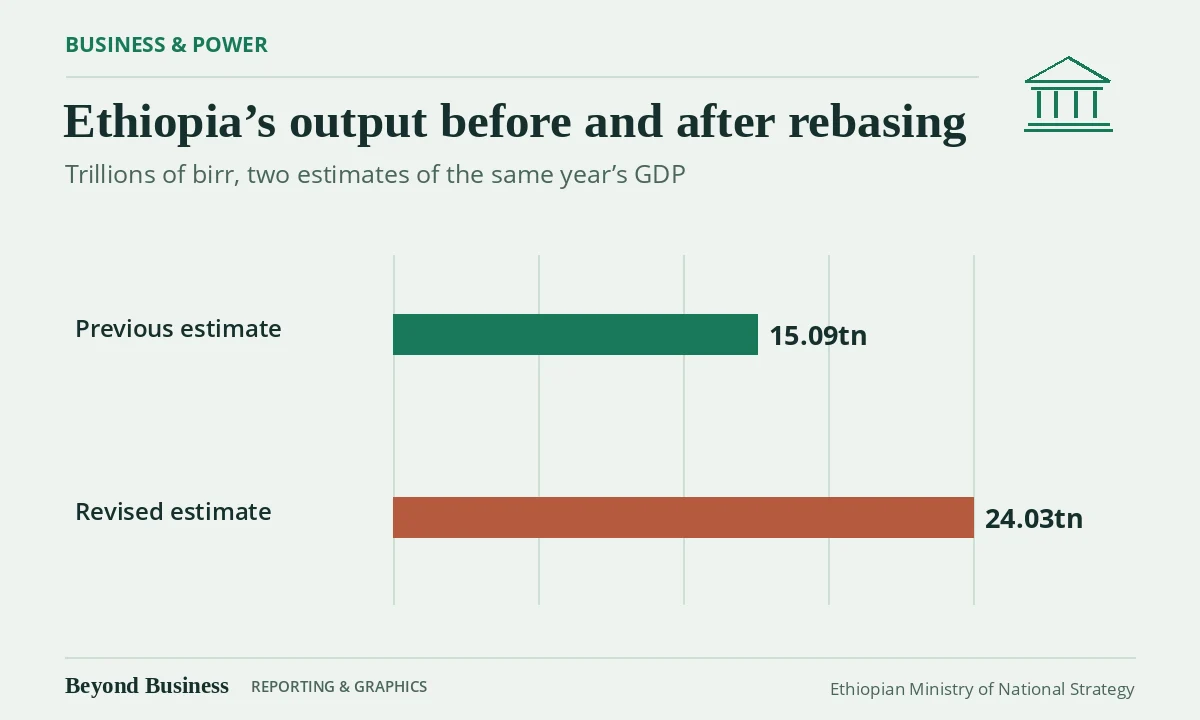
- The same year’s estimated output rose from 15.09 trillion to 24.03 trillion birr.
- Changes in the size of GDP also change ratios expressed as a percentage of GDP.
Inside this story 1 perspectives
Ethiopia presented a revision on 4 November that raised the estimated size of its economy in 2024/25 by 59.2%. The sentence requires a precise reading. The country was estimating again the activity that took place in one fiscal year. It was not comparing output in two successive years. The old estimate for that year was 15.09 trillion birr. The new estimate is 24.03 trillion birr, or about $201.4 billion in the government’s presentation.
Rebasing changes the reference year and updates how much weight different goods, services and forms of economic activity receive in national accounts. Ethiopia moved its base from 2015/16 to 2024/25. Its Ministry of National Strategy says the work also used two national censuses, broader coverage and updated methods. The result combines several changes, so it would be misleading to attribute the whole revision to the arrival of any single industry.
What had been hard to count
The ministry identifies small-scale manufacturing, informal mining, transport services, financial technology and interest-free banking among the activities better represented in the new figures. These are very different businesses. A ride offered through a platform can be visible in records that did not exist when statistical procedures were first designed. A small manufacturing enterprise can be missed because it falls outside a survey’s practical reach. Better counting can add activity to a measure without creating an extra transaction in the year being counted.
The new series also reports real growth of 7.7% for the following Ethiopian fiscal year. That number asks how the volume of activity changed over time using consistent prices. The much larger 59.2% revision asks how two estimates of the same year compare. Confusing the two would give a business an extraordinary and false impression of how quickly the demand for its products had grown.
Some of the most immediate consequences concern fractions. If the government owes the same amount and measured GDP rises, debt as a share of GDP falls. The face value due to a bondholder remains the same. Tax revenue as a share of GDP can also fall when its denominator grows, even though the revenue service collected precisely what it reported before. The two ratios can move in the same direction while inviting quite different policy discussions.
For an investor analysing a market, the revision may change the estimate of how large the economy already was and how its activities fit together. It will not, by itself, identify which firms can pay their bills or which sectors will expand next year. That is the reason to keep the old and new estimates of 2024/25 on the same line of a spreadsheet, and the next year’s real growth on a separate one.