- Berlin marked the 37th anniversary of the Wall’s opening.
- The first segments at Bernauer Strasse and Eberswalder Strasse were broken out on the night of 10 November 1989.
- Official dismantling began at another Bernauer Strasse junction in June 1990.
Inside this story 2 perspectives
The Berlin Wall fell on 9 November 1989. On a stretch of Bernauer Strasse, an equally important local date came a night later. Pieces of the Wall were knocked out near Eberswalder Strasse so that people could cross. An announcement might change the political situation in an evening. A person standing on a familiar street still needed an opening in the concrete.
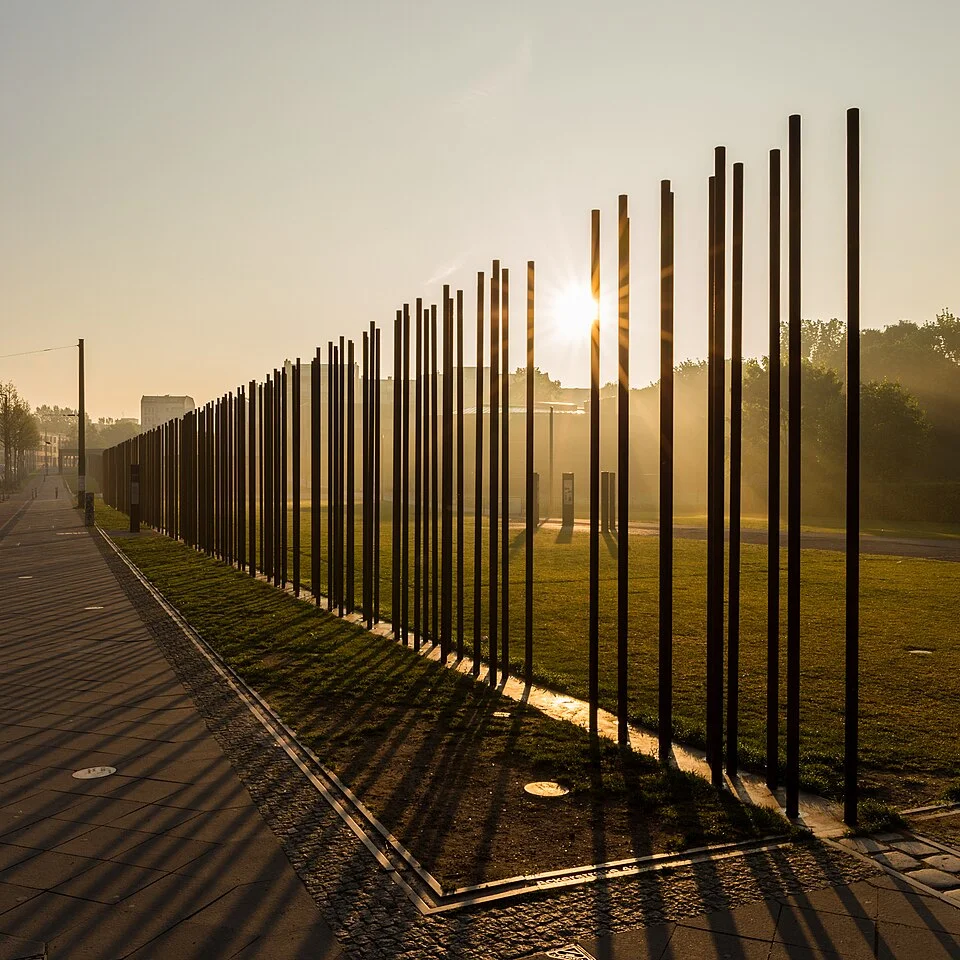
Berlin marked the 37th anniversary this November. In the city’s commemoration, roses and candles at the memorial provided a way of remembering both the opening and the people who died under the border regime. The memorial stands on a street where the physical facts of division are unusually legible. Residents, windows, doorways and the pavement immediately outside them once belonged to a geography in which a few steps could have enormous consequences.
What a street address can explain
The Berlin Wall Foundation records that ten people died in connection with the border regime in the area around the memorial. Some suffered fatal injuries trying to escape from the buildings on the street. The biographies identify individuals, addresses and dates. They return a dimension to the history that a single photograph of broken concrete cannot supply. Life along the border had changed years before spectators around the world watched people celebrate on top of it.
There are at least two approaches to walking such a site. One is to follow the big dates on the panels. The other is to stop where an account of one person’s life intersects with the street now in front of you. A visitor who knows what happened to somebody at one address has a reason to look again at the distance to the other side. Concrete and street plans can give scale to an account that otherwise sounds abstract.
The difference between opening and dismantling
The first gap at Bernauer Strasse and Eberswalder Strasse made a new east-west crossing possible. Official dismantling of the fortifications began at a different junction, at Ackerstrasse, in June 1990. Both developments followed the November opening. Telling the story in that order preserves the remarkable speed of the political change and the more gradual work of making a divided city physically passable again.
For somebody looking at an anniversary photograph, a useful question is where the camera was standing. A gap in a wall shows what a person at that angle could see and where a person could now walk. Somebody one street away might still have been waiting for the same freedom to acquire a route. In Berlin, the story of what followed 9 November is still there to read in the names of the streets.